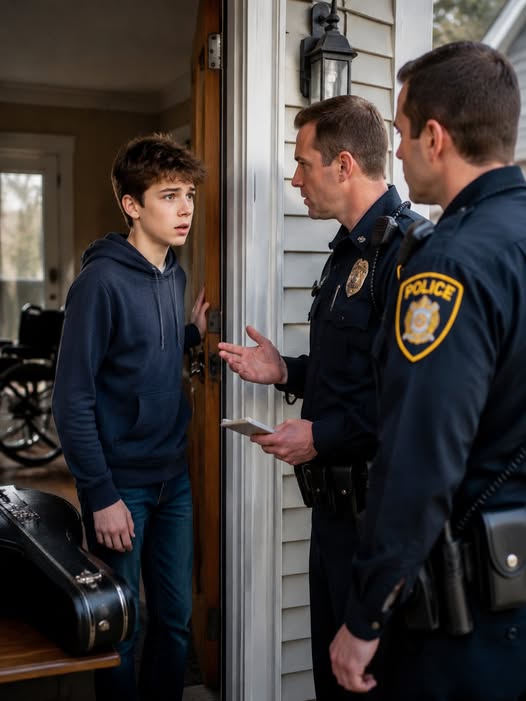
My 13-Year-Old Son Sold His Prized Guitar To Buy A Disabled Classmate A Wheelchair—But When Two Police Officers Showed Up At My Door The Next Day, They Revealed The Heart-Stopping Truth About What He Actually Did.
The knock came right after breakfast, sharp enough to make the spoon rattle in my coffee mug.
I was still in my slippers, standing at the kitchen sink, watching my thirteen-year-old son David push cereal around his bowl like it had personally offended him. He had been quiet all morning. Not sick quiet. Not sleepy quiet. The kind of quiet that sits wrong in a room, like a chair pulled away from the table and left there.
When the knock came again, David looked up so fast his spoon clinked against the ceramic.
“Mom,” he said.
Just one word.
But something in his voice made me turn before I even reached the front hall.
Through the narrow glass beside the door, I saw two police officers standing on my porch.
For one second, my brain refused to make sense of it. The uniforms. The badges. The parked cruiser at the curb. The older officer with his hands folded in front of him, the younger one glancing toward the street like he already knew there were people watching.
Police did not come to our door.
Not to our little house with the chipped blue shutters, the porch fern I kept forgetting to water, and the basketball David had left beside the steps three days ago. Police drove through the neighborhood sometimes, sure. They waved at kids riding bikes. They parked outside the school during pickup. They did not stand on my porch at nine in the morning looking serious.
David came up behind me.
I felt him before I saw him. He had that stillness children get when they are trying to decide whether to confess or run.
Advertisements
“David,” I whispered, “what’s going on?”
He shook his head.
But he would not meet my eyes.
I opened the door.
The older officer took off his hat. “Mrs. Parker?”
“Yes.”
“I’m Officer Reynolds. This is Officer Bell. Is your son David home?”
My hand tightened around the edge of the door.
“He’s here.”
David stepped into view beside me, pale and silent.
Officer Reynolds looked at him, then back at me. His face was firm, not cruel, but serious enough that every terrible possibility rushed at me at once.
Had David stolen something?
Had he gotten into a fight?
Had he been somewhere he was not supposed to be?
Had something happened after school yesterday that he had not told me?
He was only thirteen. He left wet towels on the bathroom floor and forgot to take the trash out unless I reminded him three times. He cried when we passed injured animals on the road. He gave half his lunch to a kid named Mason last year because Mason kept saying he was not hungry, and David did not believe him.
That was my son.
But that morning, with two officers on my porch and David standing next to me like he had swallowed all his words, I did not know what I was looking at.
Officer Reynolds said, “Ma’am, don’t you know what your son has done?”
My breath caught.
David’s hand brushed mine, and I grabbed it without thinking. I held on so tightly he winced.
“Mom,” he whispered.
Officer Bell glanced at him. The younger officer’s mouth twitched—not a smile exactly, but something close enough to confuse me.
Officer Reynolds continued, “You need to hear the truth.”
The truth.
That was not a comforting phrase when it came from a police officer.
“What did he do?” I asked.
My voice did not sound like mine.
David looked down at his socks. One had a hole near the toe. I remember that clearly for no good reason, maybe because my mind needed one ordinary thing to hold on to.
“Would you both come outside with us?” Officer Reynolds asked.
Outside?
That made no sense.
If my son had done something wrong, wouldn’t they want to come in? Wouldn’t they ask questions at the table? Wouldn’t they tell me to sit down?
My legs felt strangely weak as I stepped onto the porch. The morning was bright, too bright for the panic moving through me. The grass was still damp from the sprinklers. A robin hopped along the fence, fearless and stupidly cheerful.
Then I saw the cars.
Not just the police cruiser.
Three cars were parked along the curb. Then four. Then I noticed more people standing near the sidewalk, neighbors from both sides of the street, a few parents I recognized from the middle school pickup line, and two women from our church. Some held phones. One of the older neighbors had a camera around his neck. People whispered, then stopped when they realized I was looking.
My stomach dropped.
“What is this?” I asked.
David’s hand was damp in mine.
He did not answer.
Then I saw her.
Emily.
The girl from David’s class.
She sat at the end of our walkway in a brand-new wheelchair.
Not the old rusted one David had described at dinner three nights earlier. Not the squeaky chair with the torn arm pad and the wheel that pulled slightly to one side. This chair was different. Sturdy. Smooth. Clean black frame. Cushioned seat. Footrests properly adjusted. The sunlight flashed off its polished metal like it had been waiting for a morning exactly like this.
Beside Emily stood her parents.
Her mother had one hand over her mouth.
Her father was crying openly.
For a moment, I could not connect any of it.
The officers.
The neighbors.
Emily.
The wheelchair.
David.
Then Officer Reynolds smiled.
That smile confused me more than the knock had.
Police officers do not usually smile right before they ruin your life.
“Mrs. Parker,” he said gently, “your son isn’t in trouble.”
I blinked.
“What?”
“He isn’t in trouble at all.”
The breath I had been holding came out so fast I nearly stumbled.
David’s shoulders dropped, but only a little.
Officer Bell smiled now too. Fully this time.
Officer Reynolds nodded toward Emily. “Actually, we’re here because your son has done something extraordinary.”
I looked at David.
His cheeks turned red.
“David,” I said slowly, “what is going on?”
He became intensely interested in the porch boards.
To understand why I was already half terrified and half confused, you have to understand something about David and that guitar.
It was not just a guitar.
It was the guitar.
He had saved for two summers to buy it. Birthday money. Lawn mowing money. The twenty dollars his grandfather mailed him every Christmas in a card with a deer on it. Every bit of cash he got went into an old coffee can labeled GUITAR in crooked black marker.
The guitar was used, not fancy, but to David it might as well have been carved from moonlight.
He had found it at Murphy’s Music downtown, hanging on the back wall between newer instruments we could not afford. It was a honey-colored acoustic with a few scratches near the pickguard and a warm sound that filled the room even when he only knew three chords.
He picked it up the day we bought it and strummed so softly the shop owner smiled.
“That one suits you,” Mr. Murphy had said.
David looked at me as if the man had just handed him a crown.
For the next year, that guitar was part of the furniture of our lives. It leaned against his bedroom wall. It sat across his lap while he watched videos and practiced chord changes. It came with us to family cookouts, where he played the same two songs until his cousins begged him to stop. He named it June, though he refused to explain why.
Then, two days before the police came, David walked in from school quieter than usual.
He dropped his backpack by the door and went straight to the kitchen table.
“Mom,” he said, “do you know how much a wheelchair costs?”
I looked up from cutting carrots.
“That depends. Why?”
He shrugged, but his face had gone serious. “Emily’s chair is bad.”
I knew who Emily was. He had mentioned her before. A girl from his science class. Smart. Funny. Drew comic characters in the margins of her notebook. Sometimes David told me things she said, and I could tell he liked her in the honest, soft way kids like people before the world teaches them to make it complicated.
“What do you mean bad?” I asked.
“It squeaks. And yesterday the brake stuck. She laughed it off, but Mason said she almost fell getting into her mom’s car.”
“That’s awful.”
“Her parents can’t get a new one right now.”
I stopped cutting. “Did she tell you that?”
“No. I heard Mrs. Grant talking to the nurse.”
“David.”
“I wasn’t spying,” he said quickly. “I was in the office turning in my field trip form. They were right there.”
I set the knife down. “That’s private, honey.”
“I know.” He looked guilty, then frustrated. “But it’s still true.”
I did not know what to say.
There are moments as a parent when you can feel your child standing at the edge of understanding something unfair, and you want to protect them from the heaviness of it. But you also know fairness is not something they learn by being sheltered from pain.
So I said, “Sometimes families have to wait for insurance, or save money, or appeal decisions. Medical things can be expensive.”
David stared at the table.
“That’s stupid.”
“It is.”
“She needs it now.”
“I know.”
He went quiet again.
The next afternoon, his guitar was gone.
I noticed because the corner of his room looked wrong when I carried in a basket of clean laundry. The wall beside his dresser was bare. The black soft case was missing too.
I found David sitting on his bed, hands folded between his knees.
“Where’s June?” I asked.
His ears turned red.
He looked up slowly. “I sold it.”
For a second, I thought I misheard him.
“You sold your guitar?”
He nodded.
“David. Why?”
He swallowed. “To buy Emily a wheelchair.”
I sat down on the edge of his bed.
The laundry basket pressed against my knee. A sock slid to the floor. Outside, a dog barked down the street, and in the distance someone started a lawn mower.
“You sold the guitar you saved two summers for?”
He looked down. “She needed the chair more than I needed the guitar.”
I closed my eyes for a second.
There are things you want to praise as a mother, and there are things that hurt to praise because you know what they cost.
“Did Emily know?”
“No.”
“Did her parents know?”
“Not yet.”
“David.”
“I’m going to tell them,” he said quickly. “I just wanted to make sure I had enough first.”
“How did you even sell it?”
“Mr. Murphy helped me. He gave me more than it was worth.”
Of course he did.
I pictured that old music shop, the walls crowded with instruments, Mr. Murphy standing behind the counter, looking at my son and understanding exactly what he was giving up.
I put my hand over David’s.
“I’m proud of your heart,” I said. “But big decisions like that—you talk to me first. You don’t have to carry everything alone.”
He nodded.
“I know.”
But he did not look sorry.
Not really.
He looked sad, yes. He had sold something he loved. But underneath that sadness was a steadiness I did not recognize yet, a quiet certainty that he had chosen correctly.
That evening, he told me he had given the money to Emily’s parents through the school counselor, who helped arrange the wheelchair order. I cried a little in the kitchen while pretending to rinse dishes. David caught me and rolled his eyes, embarrassed.
“Mom, don’t make it weird.”
“It is already weird,” I told him. “Your thirteen-year-old moral compass is making me look bad.”
He smiled then, small and tired.
And I thought that was the whole story.
A boy sold his beloved guitar so his classmate could have a wheelchair.
A beautiful, painful, generous thing.
Enough to fill my heart and break it at the same time.
But standing on the porch the next morning, looking at the police officers, the neighbors, Emily in that new chair, and David turning the color of a tomato plant, I realized I had only known the first page.
Officer Reynolds nodded toward the wheelchair.
“You know about this part,” he said.
I nodded slowly. “He sold his guitar.”
“Yes,” the officer said. “He did.”
David shifted beside me.
Officer Reynolds looked at my son with something like admiration.
“But Mrs. Parker,” he said, “that’s only part of the story.”
### Part 2
I turned to David so fast he took half a step back.
“What does he mean?”
David pressed his lips together.
The same boy who could talk for twenty minutes about why the bass line in a song mattered suddenly could not find one word.
Officer Reynolds gave him a look that was both kind and amused.
“David,” he said, “I think your mom deserves to know.”
David rubbed the back of his neck. “I didn’t think it was a big deal.”
Emily’s mother made a sound that was half laugh, half sob.
I looked at her, then at Officer Reynolds.
“What happened?”
The officer folded his hands in front of him.
“Yesterday afternoon, after David sold his guitar and helped get Emily the new wheelchair, he learned something else.”
My heart, which had only just started behaving again, tightened.
“What?”
“That Emily’s family still owed several months of medical expenses,” he said. “And that they were struggling to keep up with physical therapy appointments.”
I turned toward David.
“You knew that?”
He shrugged. “I overheard some teachers talking.”
“David.”
“I know,” he said quickly. “I know it was private. I wasn’t trying to listen. I was just there, and they were worried, and then I couldn’t stop thinking about it.”
Emily looked down at her hands.
Her father placed one hand on the back of her chair, his fingers trembling slightly against the handle.
Officer Reynolds continued. “Most kids would hear something like that and feel bad for a minute. Maybe mention it at dinner. Then move on.”
He looked at David.
“Your son didn’t move on.”
My throat tightened.
Of course he didn’t.
That was the thing about David. He could forget his homework folder three times in one week, but if someone was hurting, he remembered every detail. He once made me pull over because he saw an elderly man trying to carry groceries in the rain. He had saved a baby bird in a shoebox and cried when the wildlife center said it probably would not survive. He noticed when people went quiet.
“What did you do?” I asked him.
He kicked lightly at the porch step with his socked foot.
“I just went around.”
“Went around where?”
“The neighborhood.”
Officer Bell laughed softly. “He means he spent almost four hours going door-to-door.”
My mouth fell open. “Four hours?”
David gave me a guilty look. “I texted you and said I was at Mason’s.”
“You told me you were doing homework.”
“I was also doing something important.”
“That is not a defense.”
“I know.”
A few neighbors chuckled, but I could barely process it.
Four hours.
My son had walked around the neighborhood after school, carrying whatever awkward courage a thirteen-year-old boy can carry, knocking on doors and asking adults for help.
“What did you say to people?” I asked.
He shrugged again, but this time it looked heavier.
“I told them there was a girl in my class named Emily. I told them she needed help paying for medical stuff. I said nobody had to give a lot. Just anything.”
Mrs. Alvarez from across the street lifted her hand.
“He knocked on my door first,” she said. “He had a notebook and looked like he was about to pass out.”
“I did not,” David muttered.
“You did,” she said. “But you kept going.”
Mr. Jenkins, who lived two houses down and complained about everything from leaf blowers to Halloween decorations, cleared his throat.
“He came to my place too. Said, ‘Sir, I know you don’t like kids walking on your lawn, but I’m not on your lawn and I’m asking for someone else.’”
A few people laughed.
Mr. Jenkins looked uncomfortable with the attention. “I gave him fifty.”
David looked at him. “You also told me to stand up straight.”
“You were slouching.”
“Because I was nervous.”
“Still.”
For the first time that morning, I almost smiled.
Officer Reynolds reached into his pocket and pulled out a folded paper.
“What started as a few dollars,” he said, “became something much bigger.”
He handed the paper to me.
My fingers shook as I unfolded it.
It was a list of names.
Dozens of them.
Neighbors. Teachers. Parents. Local business owners. People from church. Mr. Murphy from the music store. The woman who ran the bakery on Third Street. A dentist whose office was near the middle school. Mason’s parents. Mrs. Grant, the school counselor. Even Mr. Jenkins, with his fifty dollars and aggressive concern for posture.
Beside each name was a donation amount.
Five dollars.
Ten.
Twenty.
A hundred.
Three hundred.
A thousand from an anonymous donor listed only as “local business owner.”
I followed the columns all the way down to the bottom.
Then I stared.
My eyes moved over the number again because my mind refused to accept it the first time.
Over $12,000.
“Twelve thousand dollars?” I whispered.
Officer Bell nodded. “A little over.”
I looked at David.
He was bright red now.
“I didn’t mean to raise that much,” he said.
I pressed the paper to my chest because I did not trust my hands.
“You didn’t mean to?”
“I just thought maybe people would give enough for one appointment or something.”
Emily’s mother stepped forward, wiping her face with a tissue that had already surrendered.
“Yes, you did,” she said.
David shook his head. “No, ma’am. I was just trying to help.”
Emily’s father’s voice broke when he spoke.
“You have no idea what you’ve done for us.”
David’s face changed then.
Not proud.
Alarmed.
Like he had accidentally stepped into a room too full of feelings and was looking for the nearest exit.
“I didn’t want everyone to come here,” he said quietly. “I didn’t want it to be a thing.”
Emily rolled her chair closer along the walkway. The new wheels moved silently over the concrete. That sound, or the absence of it, made my throat ache.
“It is a thing,” she said.
David looked at her.
She smiled. “A good thing.”
For a moment, nobody moved.
The whole street seemed to hold its breath around two eighth graders who were better at being human than most adults I knew.
Then Emily’s father cleared his throat.
“There’s something else.”
David’s eyes narrowed. “What?”
Her father turned toward one of the cars and reached inside.
When he came back, he was carrying a large rectangular case.
Black. Hard-shell. Brand new.
Unmistakably shaped like a guitar case.
David froze.
“No way,” he said.
His voice cracked just enough to remind me he was still a child.
Emily’s father carried it up the walkway and set it gently on the grass in front of him.
David looked from the case to Emily, then to me, then back to the case.
“What is that?”
Emily’s father smiled through tears. “Open it.”
David hesitated.
He had sold his guitar willingly. I knew that. But grief had still lived in his room after it was gone. I had seen him reach toward the empty space by his dresser without thinking. I had seen him stop humming while doing homework. I had seen him pretend he did not miss it because he did not want to make his kindness look like a sacrifice.
Now his hands hovered over the latches like he was afraid the case might vanish if he touched it.
“Go ahead,” I whispered.
Slowly, he knelt.
Click.
Click.
Click.
He lifted the lid.
The morning sun fell across polished wood.
Inside was a beautiful acoustic guitar, far nicer than the one he had sold. The top gleamed warm and golden. The sides were deep brown. The strings looked untouched. Even from where I stood, I could see careful craftsmanship in the curve of the body, the clean fretboard, the glossy finish.
David stared at it.
His mouth opened, but no sound came out.
Emily’s father said, “After people heard what you did, several local music stores reached out.”
Officer Reynolds nodded. “One donated the guitar.”
A voice from the sidewalk called, “And we donated the accessories.”
A woman stepped forward with a bag in her hands. I recognized her vaguely from church, though I had never learned her name. She held out a strap, a tuner, and a pack of picks.
Mr. Murphy appeared from behind her, his gray beard catching the light.
“I threw in extra strings,” he said. “And lessons, if your mom says it’s all right.”
David looked at him. “Mr. Murphy.”
The old shop owner shrugged. “Can’t have you wandering around without a guitar. Bad for business.”
David laughed once, but his eyes were wet.
More people stepped forward.
A card from his math teacher.
A note from Mason.
A plate of muffins from the bakery.
A small envelope from the church youth group.
Nothing huge by itself.
Everything enormous together.
I covered my mouth.
I had lived in that neighborhood for years, waving across lawns and chatting in grocery store lines, thinking I knew the shape of the community around us. But that morning, I saw something I had missed. People were not just curious. They had been moved. Not by a speech. Not by a campaign. Not by a headline.
By a thirteen-year-old boy knocking on their doors because his friend needed help.
David stood up slowly, wiping his face with the heel of one hand.
“You don’t have to do this,” he told Emily.
She pointed at her chair.
“But neither did you.”
There are sentences that sound simple until they enter your chest.
That one did.
David looked at the new wheelchair, then at the guitar case, then at the crowd of people gathered on our damp lawn and cracked sidewalk.
“I just saw she needed something,” he said.
Emily’s mother pressed a tissue to her mouth.
“That is exactly why it matters.”
Officer Reynolds cleared his throat.
“And that brings us to another reason we’re here.”
David turned toward him.
The officer walked to his cruiser and opened the front passenger door. When he came back, he held a framed certificate.
The frame was simple, dark wood, with a gold seal in one corner. The paper inside looked official enough that David immediately stepped back.
“Am I supposed to sign something?”
People laughed.
Officer Bell grinned. “No, son.”
Officer Reynolds handed the frame to him.
David took it carefully, as if it might be breakable in a way glass was not.
At the top were the words:
Community Youth Service Award
David read them, then looked up.
“This is for me?”
“Yes,” Officer Reynolds said. “Normally, this award goes to adults. Volunteers. Organizers. People who lead community service efforts.”
He paused.
“But sometimes a young person reminds us what real leadership looks like.”
The neighbors began to clap.
At first, it was soft. A little uncertain, as if everyone was checking whether it was all right to make noise in a moment this tender.
Then it grew.
Hands clapping from the sidewalk, the street, the grass, the porch next door. Emily’s father clapped with one hand against the other while wiping his face. Mrs. Alvarez cried openly. Mr. Jenkins clapped exactly three times, stopped, then seemed to decide he was not done and started again.
David looked overwhelmed.
He held the certificate in one hand, the guitar case at his feet, the entire neighborhood applauding him, and all I could see was my little boy at four years old trying to feed crackers to ants because he was afraid they were hungry.
Same heart.
Longer legs.
Officer Reynolds placed a hand on David’s shoulder.
“Most people spend their lives asking what the world can do for them,” he said. “Your son asked what he could do for someone else.”
My eyes burned.
I wanted to say something to David, something perfect enough for the moment, but every sentence I reached for felt too small.
So I squeezed his shoulder instead.
He leaned against me for half a second, just barely, still thirteen enough to be embarrassed by public affection, still young enough to need it.
The gathering slowly began to loosen.
People hugged Emily’s parents. Neighbors introduced themselves to one another even though many had lived on the same street for years. Officer Bell posed for a picture with David and Emily while David tried to smile like he was not seconds away from fleeing into the house.
Mrs. Alvarez told me, “You raised him well.”
I did not know how to answer that.
Because yes, I had tried.
I had taught him to say please and thank you. To hold doors. To apologize when he was wrong. To look adults in the eye. To put his laundry in the hamper, though that lesson had not taken.
But this?
This had come from somewhere deeper than chores and manners.
This had come from the part of a child that sees suffering and refuses to step around it.
Mr. Murphy bent to close the guitar case, but David stopped him.
“Can I look at it again?”
Mr. Murphy smiled. “It’s yours.”
David touched the edge of the guitar with one finger.
Not grabbing.
Not claiming.
Just making sure it was real.
I wondered then whether kindness always returns to us so beautifully.
I knew it did not.
That was part of why the morning hurt so much. Children should be kind because kindness matters, not because the world always rewards it. Plenty of good deeds are never applauded. Plenty of sacrifices remain invisible. Plenty of people do the right thing and still lose something they loved.
But that morning, for once, the world answered a good heart with open hands.
And I was grateful David got to see that.
Officer Reynolds shook my hand before he left.
“I hope we didn’t scare you too badly, ma’am.”
I gave him a look.
“You led with ‘don’t you know what your son has done.’”
Officer Bell winced. “In his defense, he was trying to be dramatic.”
Officer Reynolds coughed. “I may have misjudged the delivery.”
“You think?”
David laughed then, finally, a real laugh.
It loosened something in all of us.
The officers headed back toward their cruiser. People drifted toward cars and porches. The street slowly returned to its ordinary shape, though nothing felt ordinary anymore.
Before long, only a few of us remained in the yard.
Emily rolled beside David, her hands resting lightly on the wheels.
“I like the guitar,” she said.
David looked at the case. “I like the wheelchair.”
They both laughed.
For the first time all morning, the tension vanished completely.
Then Emily looked down at her lap, her fingers tracing the seam of her jeans.
“You know,” she said, softer now, “before this happened, I thought nobody noticed me.”
David frowned. “What do you mean?”
She glanced toward the street, where the last car was pulling away.
“People notice the chair,” she said. “They notice when I need help getting through a doorway or when the ramp is too steep or when I’m in the way. They notice the wheelchair.”
Her mouth pressed into a small line.
“They don’t always notice me.”
No one spoke.
Emily’s mother turned her face away.
My son stood very still.
Then Emily looked at him and smiled through tears.
“But you did.”
David shrugged, almost helpless against the weight of being thanked.
“I just saw my friend.”
Emily’s eyes filled.
So did mine.
Because sometimes kindness is not about doing something huge.
Sometimes it starts with seeing someone who feels invisible.
David looked down at the certificate in his hands, then at Emily’s new chair, then at the guitar case in the grass.
He whispered, “I didn’t know everybody would find out.”
Emily smiled at him.
“Maybe they needed to.”
### Part 3
After everyone left, our front yard looked like a celebration had wandered through and forgotten to clean up after itself.
There were shoe prints in the damp grass. A muffin crumb trail near the porch steps. A card someone had dropped by the flower bed. The guitar case sat just inside the doorway because David refused to take it upstairs until he had carried it “the right way,” though neither of us knew what that meant.
For a while, we did not talk.
David went to his room with the certificate, then came back down five minutes later and asked if it looked weird on his desk. Then he moved it to the bookshelf. Then back to the desk. Then he said he did not care where it went, which meant he cared deeply.
I let him have that.
Teenagers need privacy, even when their emotions are spilling all over the furniture.
I made grilled cheese for lunch because neither of us had eaten much breakfast. David sat at the kitchen table with his new guitar case beside him, one foot resting against it like he was afraid someone might take it away.
“You know,” I said, flipping a sandwich, “you are still in trouble for telling me you were at Mason’s house when you were actually going door-to-door raising twelve thousand dollars.”
He looked up.
“But it was for a good reason.”
“Good reasons do not erase bad communication.”
“That sounds like something from a school poster.”
“It should. I’m very wise.”
He smiled into his glass of milk.
“I’m sorry,” he said.
“I know.”
“I didn’t want you to tell me no.”
I turned from the stove.
That was honest.
“Would you have listened if I did?”
He thought about it.
“No.”
“At least you’re consistent.”
“I just knew people would say it was too much.”
I slid the sandwich onto his plate. “It was a lot.”
“She needed help.”
“I know.”
He looked down, picking at the crust. “I didn’t want Emily to feel like a project.”
That stopped me.
He kept going, slowly now, choosing words like stones across water.
“That’s why I didn’t want to make a big thing at school. I didn’t want everybody staring at her like, look at the poor girl with the wheelchair. I just wanted her to have what she needed.”
I sat across from him.
That morning had already given me more reasons to be proud than I could hold, and somehow he kept adding to them.
“David,” I said, “that is a very thoughtful thing to worry about.”
He shrugged. “She’s my friend.”
As if friendship explained everything.
Maybe it did.
After lunch, he finally carried the guitar upstairs. A few minutes later, I heard the first hesitant chord.
Then another.
Then silence.
Then the same chord again, clearer.
I stood at the bottom of the stairs and listened.
The sound was different from his old guitar. Fuller. Brighter. But beneath it was the same boy learning how to turn feeling into music.
I thought about the old guitar, the one he had sold without telling me. A part of me still ached for it. Not because the new one was not beautiful, but because I knew what the first one meant. It had been proof of patience. Proof that a child could want something and work for it one crumpled dollar at a time.
And he had let it go.
Not because he stopped loving it.
Because he loved someone else’s need more.
That kind of choice can make a mother proud and afraid at the same time.
Proud because compassion is a beautiful thing.
Afraid because the world is very willing to take from people who give too easily.
I knew my job now was not to make David less kind.
It was to teach him that kindness and boundaries could live in the same heart.
That helping someone did not mean disappearing into the help.
That carrying a burden for a while did not mean it belonged to you forever.
But that lesson could wait until tomorrow.
That day, I let him play.
In the afternoon, Emily’s mother called.
Her voice shook when I answered.
“Mrs. Parker, I hope it’s okay that I’m calling.”
“Of course.”
“I just wanted to say thank you again. I know we said it this morning, but it didn’t feel like enough.”
I looked toward the stairs, where David was now picking his way through a song he had learned months earlier.
“I’m not sure there is an enough for today,” I said.
She gave a watery laugh. “No. I guess not.”
There was a pause.
Then she said, “Emily hasn’t stopped smiling.”
I closed my eyes.
The image came easily: Emily rolling through her house in that new chair, testing corners, discovering what moved smoothly now, what did not hurt, what did not embarrass her, what did not make her feel like an inconvenience.
“I’m glad,” I said.
“She said she wants to write David a note. Not a big one. Just something.”
“He’d like that.”
Another pause.
“She told me she feels seen.”
The word sat between us over the phone.
Seen.
Such a small word for such a large human need.
I gripped the counter.
“He sees people,” I said.
“He does,” she replied. “That’s rare.”
After the call, I went into the living room and sat alone for a few minutes.
The house was quiet except for the guitar upstairs and the soft ticking of the wall clock. Morning replayed in pieces: the knock, the uniforms, David’s pale face, Emily in the sunlight, the list of names, the applause, the certificate, the way David said he just saw his friend.
I thought about all the things parents worry about.
Grades.
Screen time.
Attitude.
Whether they say thank you to relatives.
Whether they will make good friends or bad choices.
Whether they will remember to brush their teeth without being threatened.
We spend so much time correcting the small things that sometimes we forget to notice the larger shape forming in front of us.
David still needed reminders. He still left socks inside out in places socks had no business being. He still groaned when asked to unload the dishwasher. He still occasionally believed body spray counted as showering.
But beneath all that ordinary teenage chaos, something steady had taken root.
That evening, after the sun began to lower, I found him sitting on the porch with the new guitar across his lap.
The sky had turned orange and gold, with thin pink clouds stretched over the rooftops. The neighborhood looked almost too peaceful after the morning it had witnessed. Sprinklers clicked on down the block. A dog barked once, then gave up. Somewhere, someone’s grill smoked with the smell of charcoal and summer.
David’s fingers moved carefully over the strings.
He was not playing a full song yet.
Just notes.
Warm, uncertain, gentle notes that drifted through the evening air and seemed to settle over the porch like dust.
I sat beside him on the top step.
For a while, neither of us spoke.
That was one of the nice things about David. He did not always need words, and neither did I.
Finally, I asked, “Why didn’t you tell me everything?”
He kept his eyes on the guitar.
His thumb brushed one string.
“I told you about the wheelchair.”
“You did.”
“I didn’t tell you about the money because…” He stopped.
“Because?”
He looked across the street, toward Mrs. Alvarez’s house.
“Because helping someone shouldn’t be about getting attention.”
I felt tears rise again, and this time I did not bother hiding them.
At thirteen, my son understood something some adults spend their whole lives avoiding.
True kindness is not a performance.
It does not reach for applause before it reaches for the person hurting.
It does not calculate whether the story will make us look generous.
It does not ask, what will I get back?
It asks, can I make this burden lighter?
I wrapped my arm around his shoulders.
He let me, which meant the day had taken more out of him than he wanted to admit.
“You know,” I said, “when the police showed up this morning, I thought my whole world was about to fall apart.”
David winced. “Sorry about that.”
“You should be. Officer Reynolds needs a class in delivery.”
He laughed, the sound soft and tired.
Then he leaned into me just a little.
“I didn’t know they were coming like that,” he said. “Mrs. Grant said some people wanted to thank me. I thought maybe like, a card.”
“A card?”
“Maybe a cupcake.”
“Instead, you got two police officers, half the neighborhood, a certificate, and a guitar.”
He grimaced. “It was a lot.”
“It was.”
“I didn’t hate the guitar part.”
“I noticed.”
He smiled down at the strings.
The porch boards were warm under my feet. The air smelled like grass and charcoal. In the distance, kids rode bikes over the uneven sidewalk, their laughter rising and fading.
I kissed the top of David’s head.
“No,” I said quietly.
He looked at me. “No what?”
“No, you don’t need to be sorry for today.”
My voice tightened, but I kept going.
“You gave me one of the proudest days of my life.”
His face changed.
Thirteen-year-old boys do not always know what to do with praise, especially praise that arrives without teasing. He looked away, blinked hard, and adjusted the guitar even though it was already sitting perfectly fine.
“Mom.”
“I know,” I said. “I’m making it weird.”
“You are.”
“I’m your mother. It’s legally required.”
He shook his head, but he was smiling.
Then he began to play again.
This time, the notes formed something closer to a song.
Not perfect.
Not polished.
But honest.
I listened as the sun slipped lower behind the houses.
I thought about Emily and her new chair. Her parents, crying in our yard. Officer Reynolds with his dramatic knock and poor timing. Mr. Jenkins donating money and posture advice. Mr. Murphy giving back music to a boy who had traded his own for kindness. All those names on the list, each one a small proof that compassion is contagious when someone is brave enough to start it.
One act had moved from David to Emily.
Then from Emily to her parents.
Then to a teacher.
A neighbor.
A shop owner.
A church group.
A police department.
An entire street.
Kindness had multiplied, not because it was shouted from a stage, but because one boy knocked on doors with a notebook in his hand and nervous courage in his chest.
I used to think big change came from big people.
People with money.
Titles.
Organizations.
Plans.
But that day taught me something else.
Sometimes change begins with a child who cannot stop thinking, She needs it now.
Sometimes it begins with a guitar case going empty.
Sometimes it begins when someone looks at a classmate and sees more than the chair, more than the struggle, more than what everyone else has learned to politely ignore.
Emily had said people noticed the wheelchair, but not always her.
David saw his friend.
That was the whole miracle.
Not the money, though the money mattered.
Not the award, though I knew I would keep that certificate safe until the paper yellowed at the edges.
Not even the guitar, beautiful as it was.
The miracle was that my son had recognized someone else’s dignity and treated it like something worth protecting.
Later that night, after David went to bed, I found the donation list on the kitchen counter.
I thought he had left it there by accident, but when I picked it up, I saw he had written something on the back in pencil.
For Emily’s therapy.
Not for me.
Not for award.
Just help.
The handwriting was messy, uneven, still partly a child’s.
I stood under the kitchen light and ran my fingers over the words.
All day, people had told me David was extraordinary.
And he was.
But he was also still thirteen.
He still needed someone to remind him to lock the back door. He still had math homework folded into the bottom of his backpack. He still thought cereal counted as dinner if eaten after six. He still needed me to guide him, protect him, and help him grow into the kind of man who could keep his tenderness without letting the world drain him dry.
So the next morning, I made pancakes.
David came downstairs in the same T-shirt he had slept in, hair sticking up in the back, yawning like a cat.
The certificate was under one arm.
“Are we hanging it?” I asked.
“Maybe.”
“Kitchen? Living room? Your room?”
He sat at the table. “Can we put it somewhere not embarrassing?”
“So, inside a locked drawer?”
He gave me a look.
I smiled and slid a plate toward him.
“We’ll find a place.”
He poured too much syrup and said, “Emily texted me.”
“Oh?”
“She said she got around her whole kitchen without the wheel sticking.”
His smile was small, private, and brighter than any award.
“That’s wonderful,” I said.
“Yeah.”
He took a bite, then looked at me.
“Can I still take lessons with Mr. Murphy?”
“Yes.”
“And can Emily come over sometime?”
“Of course.”
“Not because of the chair thing. Just to hang out.”
“I know.”
He nodded, satisfied.
Then, after a moment, he said, “I still miss June.”
There it was.
The cost.
I reached across the table and touched his hand.
“I know you do.”
“I like the new guitar,” he said quickly.
“You can like the new guitar and still miss the old one.”
He thought about that.
“Is that weird?”
“No. That’s honest.”
He looked down at his pancakes.
“I don’t regret it.”
“I know.”
“I’d do it again.”
I believed him.
That scared me a little and made me proud all over again.
“Then next time,” I said carefully, “you come to me first. Not so I can stop you. So I can help you carry the plan safely.”
He looked up.
“You wouldn’t have stopped me?”
“I might have slowed you down.”
He frowned.
“Mom.”
“David, kindness matters. But so does safety. So does permission. So does making sure the people you’re helping are comfortable with how help is given. Emily is a person, not a project.”
He nodded slowly.
“I know.”
“I know you know. I’m saying it anyway.”
“Because you’re my mom.”
“Exactly.”
He smiled into his pancakes.
We hung the certificate that afternoon in the hallway near the front door.
David wanted it lower at first, then higher, then slightly to the left. Finally, we placed it where anyone entering the house could see it, but not in a way that felt like a trophy wall. Just a reminder.
A reminder that goodness can live in ordinary houses.
That children are always watching what burdens adults ignore.
That one quiet decision can grow into something no one expected.
For weeks afterward, people stopped us at the grocery store, at church, outside school.
“Your boy did a wonderful thing.”
“You must be so proud.”
“We need more kids like him.”
David hated the attention, but he learned to say thank you without folding into himself. Emily got stronger with therapy. Her new chair became part of her, then stopped being the first thing people mentioned. She and David stayed friends, trading homework complaints, music recommendations, and private jokes I was not allowed to understand.
Sometimes I watched them from the kitchen window when she came over.
David would sit on the porch with his guitar while Emily parked her chair beside the steps, both of them talking about school or songs or some ridiculous video everyone their age seemed to know. He never hovered over her. Never acted like she was fragile. Never treated her gratitude like something she owed him forever.
He simply made space.
And she filled it.
That, more than anything, told me his kindness had been the right kind.
Not pity.
Recognition.
Months later, the police department invited David to a community event. He stood awkwardly beside Officer Reynolds while people clapped again. He wore a button-down shirt I had ironed twice because he kept wrinkling it in the car. Emily was there too, rolling herself through the crowd with confidence that made her mother cry quietly beside me.
Officer Reynolds leaned toward me and said, “I improved my speech this time.”
“You had nowhere to go but up,” I said.
He laughed.
David gave a short thank-you that lasted exactly twenty-seven seconds.
“I didn’t do it by myself,” he said, staring at the microphone like it might bite him. “Everybody helped. And Emily is my friend, so… yeah. Thanks.”
That was it.
The crowd loved him more for it.
On the drive home, he said, “I am never doing public speaking again.”
“You did fine.”
“I said ‘so yeah’ into a microphone.”
“It was charming.”
“It was terrible.”
“It was honest.”
He looked out the window, thinking.
Then he said, “I meant it, though. Everybody helped.”
“Yes,” I said. “But you started.”
He was quiet the rest of the way home.
That night, I heard him playing the new guitar in his room. The song was smoother now, his fingers more confident. I stood in the hallway for a moment and listened, not wanting to interrupt.
The notes moved through the house, warm and gentle.
Hopeful.
I thought again of that first knock on the door.
The fear.
The officers.
David’s pale face.
My hand gripping his so tightly he winced.
I had thought the truth was something terrible coming toward us.
Instead, the truth was my son had been walking door to door, carrying more compassion than his small shoulders should have been able to hold, asking people to help a girl who thought nobody saw her.
That truth changed me.
It changed the way I looked at my child.
It changed the way I looked at my neighborhood.
It changed the way I understood kindness.
A single act of compassion can seem small when it begins.
A guitar sold.
A door knocked.
A few dollars gathered in a notebook.
But kindness does not always stay small.
Sometimes it spreads quietly from one person to another, from one kitchen table to the next, from one heart to the next, until suddenly an entire community is standing in a front yard, clapping for a boy who never wanted applause.
All because one thirteen-year-old looked at a struggling classmate and decided she mattered.
And by doing that, he reminded the rest of us that we all do.
The End