Collecting dusty shoeboxes, learning to text at 78, growing mint for a son who mentioned it once — grandmothers have always spoken love and empathy in a language the rest of us are still learning to read. Their quiet acts of kindness and unconditional family love don’t make headlines, but they build the kind of legacy that holds a family together long after the person is gone. These 11 stories are proof.
1.
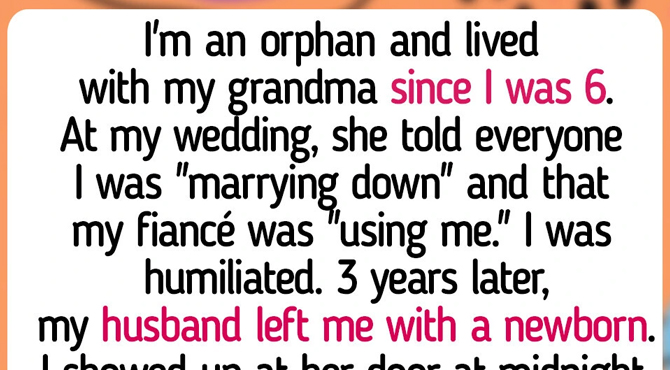
I’m an orphan and lived with my grandma since I was 6. At my wedding, she told everyone I was “marrying down” and that my fiancé was “using me.” I was humiliated.
3 years later, my husband left me with a newborn. I showed up at her door at midnight. She opened it and yelled, “What took you so long?! I’ve had your room ready for months!”
She pulled me inside, already holding my baby. “I knew he’d leave. I’ve been praying you’d come home before you hit rock bottom.”
Then she showed me the nursery she’d been quietly preparing—crib, clothes, everything. “I was harsh at your wedding because I hoped you’d call it off. When you didn’t, I knew I had to prepare for this day instead.”
She raised my daughter with me, never once saying “I told you so.” Years later, she admitted, “Being right doesn’t matter. Being there when you’re wrong does.”
2.
There was a rule in my grandmother’s house that was never spoken aloud but was absolute and total: nobody left without eating something.
It did not matter if you were a stranger who had come to fix the boiler. It did not matter if you had just arrived and said you weren’t hungry and genuinely meant it. By the time you were leaving there would be something — a plate, a bowl, a wrapped portion for the road.
She fed the plumber, she fed the postman, she fed every friend any of her grandchildren ever brought through that door. And she did it not because she was performing hospitality but because in her understanding of the world, feeding someone was simply what you did when they were in front of you.
That instinct cost her nothing and built something in everyone who experienced it that I don’t have a better word for than warmth.
3.
My grandmother had a drawer in her kitchen that nobody was allowed to open except the grandchildren.
Inside was a chaos of small things she had collected over the years that she associated with each of us — a sticker I had liked when I was five, a drawing my cousin made that she had kept for decades, a button that had fallen off my jacket during a visit when I was seven and that she had apparently saved because she thought I might want it back.
None of it was valuable. All of it said the same thing: I was here. She noticed, and she kept the evidence.
4.
After my grandmother passed, we found a shoebox in her wardrobe containing letters she had written to each of her grandchildren at different points over the years.
Mine were dated — one from when I was born, one from when I started school, one from the year I went through something difficult as a teenager that I thought nobody had fully understood. She had never mentioned writing them.
The letter from my teenage year began: I noticed you seemed far away this year and I didn’t want to crowd you, but I wanted you to know I was paying very close attention. She had been waiting for the right moment to give them to me, and then she ran out of time, and somehow that made them the most important thing I have ever read.
5.
My grandma was 78 when I moved abroad for work. She had never owned a smartphone in her life and had no interest in technology of any kind. But within two weeks of my leaving, she had asked my cousin to teach her how to send text messages.
The texts she sent were extraordinary — no punctuation, random capitalization, often just a single word like COLD or SUNDAY or THINKING. But they arrived every single morning without exception for four years until she passed.
I would give anything to receive one more message that just said MORNING in capital letters with no punctuation from a woman who taught herself something completely foreign to her because she refused to let me wake up in a different country and not feel her there.