I never told my husband about my $2 million inheritance.
He always treated me like a servant.
I silently endured it for 15 years.
And then he brought his mistress to our home.
What I did next… I’m glad you’re here with me.
Please like this video and listen to my story until the end, and let me know which city you’re listening from.
That way, I can see how far my story has traveled.
I never imagined that keeping a secret could save my life.
For 15 years, I lived in that two-story colonial house in suburban Ohio, cooking, cleaning, doing laundry, and playing the role of the perfect housewife.
My husband, Richard, never knew about the $2 million my grandmother left me when I was 28.
I had my reasons for keeping it hidden, and those reasons became clearer with every passing year.
Back then, when Grandma Rose passed away, Richard and I had only been married for three years.
We were young, supposedly in love, building our future together.
But even then, I noticed small things: the way he’d make decisions without asking me, how he’d criticize my cooking if dinner wasn’t ready exactly at six, the condescending tone when he explained things I already knew.
My mother always said:
“Margaret, don’t rush to share everything. A woman needs something of her own.”
I thought she was old-fashioned.
Turns out she was right.
I deposited that inheritance in a separate account my grandmother had helped me set up years before, at a different bank across town.
Richard never asked about my errands there.
Why would he?
I was just his wife, running household tasks—nothing important.
The money sat there quietly growing while I scrubbed his floors and ironed his shirts.
The years passed like pages in a book I couldn’t put down, even though I hated the story.
Richard climbed the corporate ladder at his accounting firm, earning more each year.
But our life never really changed.
We didn’t take vacations I wanted.
We didn’t remodel the kitchen I cooked in every single day.
His needs, his career, his preferences—they filled every corner of our existence.
And I was the backdrop, the supporting character in Richard’s life story.
Was I unhappy?
Sometimes.
Was I aware of how small I’d become?
Not really.
It’s strange how you can lose yourself one tiny compromise at a time.
One dismissed opinion.
One eye roll when you speak.
By year ten, I’d stopped sharing my thoughts at dinner parties.
By year twelve, I’d stopped having thoughts worth sharing—or so I believed.
Then came that Tuesday in March.
I remember because it was trash day, and I’d just hauled the bins to the curb when I saw an unfamiliar silver BMW in our driveway.
Not parked on the street—in our driveway, bold as brass.
I walked back into the house through the kitchen door, wiping my hands on my apron, expecting maybe a colleague of Richard’s dropping by unexpectedly.
What I found instead rewrote everything.
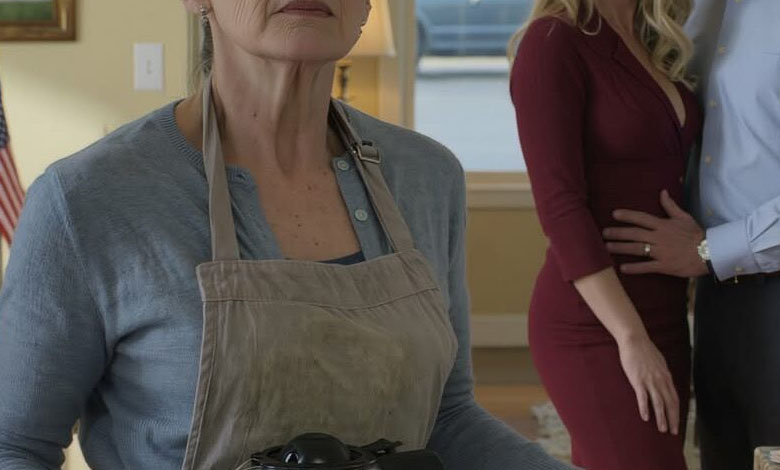
Richard was in our living room.
The living room where we’d celebrated Christmases, where we’d hosted his boring work dinners, where I’d arranged flowers every week for 15 years.
He was there with a woman I’d never seen before.
She was younger, maybe forty, with carefully highlighted hair and a burgundy dress that cost more than my entire wardrobe.
They weren’t just talking.
They were standing close—too close.
And Richard had his hand on her waist in a way he hadn’t touched me in years.
The intimacy of it, the casual ownership in that gesture, told me everything I needed to know.
This wasn’t new.
This wasn’t a mistake.
This was established, comfortable, real.
I must have made a sound because they both turned.
The woman had the decency to look startled.
Richard looked annoyed.
Not guilty.
Not apologetic.
Annoyed that I’d interrupted.
“Margaret,” he said, his voice carrying that familiar edge of impatience. “This is Vanessa. We have some business matters to discuss. Could you make us some coffee?”
Could I make them coffee in my house?
After walking in on my husband with another woman, he wanted me to serve them refreshments.
The world tilted sideways for a moment.
Fifteen years of small humiliations crystallized into one perfect, sharp point of clarity.
I looked at Vanessa, who was now smiling—actually smiling—with a mixture of pity and triumph in her eyes.
I looked at Richard, who was already turning back to her, dismissing me.
And I thought about the $2 million sitting in that account across town, the money he knew nothing about, the secret that was about to become my weapon.
“Of course,” I heard myself say, my voice steady and distant. “I’ll put the coffee on right away.”
I walked to the kitchen, my hands trembling only slightly, and began to plan.
I stood there measuring coffee grounds with mechanical precision while my mind raced through 15 years of marriage like flipping through a photo album that suddenly made horrible sense.
How long had this been going on?
Months?
Years?
And how many times had I been this blind, this trusting, this pathetically domestic?
The coffee maker gurgled to life, and I gripped the counter, forcing myself to breathe.
Through the doorway, I could hear their voices—low, intimate—punctuated by Vanessa’s laugh.
That laugh was light and carefree, the sound of a woman who wasn’t expected to clean up after herself or worry about whether the pot roast would be dry.
What had I lost?
The question hammered through my shock.
I’d lost my career.
I’d been a promising accountant myself once, before Richard convinced me we didn’t need two people chasing promotions.
Wouldn’t it be better if someone managed the home properly?
I’d lost my friends gradually as Richard found reasons why we couldn’t attend their gatherings, or why my book club night conflicted with his networking dinners.
I’d lost my identity piece by piece until I was just Richard’s wife, the woman who kept his house and asked for nothing.
And what had Richard lost?
Nothing.
He’d gained everything: a clean house, home-cooked meals, a presentable spouse for company events, and apparently the freedom to parade his mistress through our living room while I made them coffee.
The rage came then—cold and clarifying.
Not the hot, explosive anger that makes you scream and throw things.
This was different.
This was ice forming over a deep lake—hard and clear and dangerous to anyone who tried to walk on it.
I arranged three cups on a tray with steady hands.
Added cream and sugar.
Found the good cookies I’d baked yesterday for him.
Always for him.
As I worked, a thought crystallized.
Richard didn’t know about the money.
That ignorance was power.
The only power I’d had in years, and I’d kept it without even realizing I was protecting myself.
What could $2 million buy?
Freedom, certainly.
But more than that, it could buy justice.
Revenge, maybe.
Or maybe just the life I should have been living all along.
I carried the tray into the living room.
They’d separated slightly, probably thinking they’d been subtle earlier.
Vanessa was perched on my sofa, legs crossed elegantly, while Richard stood by the window, looking like a man who owned everything in sight.
“Here we are,” I said pleasantly, setting down the tray. “Fresh coffee. The cookies are chocolate chip. I just baked them yesterday.”
Vanessa’s smile was saccharine.
“How domestic of you. Richard told me you’re quite the homemaker.”
“Has he?” I poured coffee with a steady hand. “How nice that you two have such detailed conversations.”
The barb landed, but lightly.
Richard frowned.
“Margaret, Vanessa is a consultant on a project at the firm. We’re discussing.”
“I’m sure it’s very important,” I interrupted gently. “I’ll leave you to it. I have errands to run anyway.”
That was true.
I did have errands now—very specific ones.
Richard looked relieved.
“Take your time. We’ll be a while.”
I collected my purse and keys, walking past them with my head high.
Neither of them knew they’d just handed me the final piece of information I needed.
Richard wasn’t even trying to hide this anymore.
That meant he felt secure.
Untouchable.
That meant he thought I had no options.
Men like Richard always underestimated women like me.
In the car, I sat for a moment, gripping the steering wheel.
My phone was in my hand before I consciously decided to pick it up.
I had three calls to make, and I knew exactly who to contact first.
Diana Marsh.
We’d been friends in college before Richard gradually edged her out of my life, claiming her divorce made her toxic to be around.
Diana was a family law attorney now—one of the best in the state.
We’d exchanged Christmas cards every year, mine always cheerful and impersonal, hers always with a handwritten note:
“Call me if you ever need anything.”
My finger hovered over her number.
This was the point of no return.
Once I made this call, once I set things in motion, there would be no going back to the comfortable numbness of my old life.
I thought about Vanessa’s triumphant smile.
About Richard’s casual dismissal.
About fifteen years of making myself smaller and smaller until I almost disappeared.
I pressed dial.
“Diana,” I said when she answered, “it’s Margaret Chen. Remember when you said to call if I ever needed anything? I need something now. I need a divorce attorney—and I need someone Richard won’t see coming.”
There was a pause.
Then Diana’s voice came through, sharp and alert.
“I’ve been waiting for this call for ten years. Don’t say another word until you’re in my office. Can you come now?”
“I’m already driving,” I said.
And I was—away from that house, away from that life, toward something I couldn’t quite see yet, but knew was mine for the taking.
Diana’s office was in a steel-and-glass building downtown, the kind of place I never went anymore.
As I rode the elevator to the twelfth floor, I caught my reflection in the polished doors: a 63-year-old woman in a plain cardigan and comfortable shoes, clutching a worn purse.
I looked exactly like what I was—a housewife.
Harmless.
Invisible.
Perfect.
Diana stood when I entered her office, and I saw the shock flicker across her face before she controlled it.
I must have looked worse than I thought.
She came around her desk and pulled me into a hug that almost broke my careful composure.
“Sit,” she said firmly. “Talk.”
So I did.
I told her everything: the years of casual dismissal, the gradual erosion of my identity, and finally today’s humiliation.
Diana listened with the focused attention of a surgeon examining a patient, taking notes occasionally, but mostly just watching my face.
When I finished, she leaned back in her chair.
“Okay. First question: Do you want to save this marriage?”
“No.”
The word came out so quickly, so certainly, that we both paused.
I’d surprised myself.
But it was true—utterly, completely true.
I didn’t want counseling or second chances.
I wanted out.
“Good,” Diana said. “Because from what you’re describing, Richard is the type who will use therapy as another platform to explain why everything is your fault.”
“Second question: assets. What are we working with?”
This was the moment.
I took a breath.
“Richard thinks we have about $400,000 in combined retirement accounts and maybe $60,000 in savings. Our house is worth approximately $550,000 with $300,000 left on the mortgage.”
Diana was already calculating, her pen moving across paper.
“So roughly $900,000 in marital assets minus the mortgage. That’s not bad. You should expect close to half, maybe a bit more given the length of the marriage and your—”
“And I have $2 million he doesn’t know about,” I said quietly.
Diana’s pen stopped.
“What?”
“My grandmother left it to me three years after we married. I never told him. It’s in a separate account. Has been for fifteen years.”
Diana set down her pen very carefully.
“Margaret, that’s… that’s separate property if you inherited it before the marriage or kept it completely separate. But fifteen years during the marriage—if there’s been any co-mingling—”
“There hasn’t,” I said. “Not a penny. Separate account, separate bank. Never touched. My grandmother set it up specifically to stay separate. She didn’t trust Richard.”
A slow smile spread across Diana’s face.
“Your grandmother was a smart woman. Okay. This changes everything. With that safety net, we can play hard ball. But here’s the critical thing: Richard cannot know about this money until the absolute last possible moment. If he finds out early, he’ll claim you hid marital assets, and it gets messy.”
“So what do we do?”
Diana pulled out a fresh legal pad.
“We document everything. Every instance of infidelity you can prove. Every asset he might be hiding. Every penny he’s spent on Vanessa. We build a case so airtight that when we finally strike, he has no room to maneuver.”
“How’s your memory? Can you recall specific incidents?”
I thought about fifteen years of keeping my mouth shut.
Of noticing everything and saying nothing.
“Yes,” I said. “I can recall.”
“Start talking. Dates, times, details—everything.”
We worked for three hours.
Diana’s assistant brought us coffee and sandwiches, which I barely touched.
I talked until my throat was raw, pulling up memories I’d buried.
Expensive gifts that appeared and disappeared.
Unexplained late nights.
Credit card charges to restaurants I’d never been to.
Diana’s face grew grimmer with each detail.
“He’s been careful,” she said finally. “But not careful enough. Men like Richard get cocky. They think their wives aren’t paying attention.”
“But you were paying attention, weren’t you, Margaret?”
“Always,” I said. “I just didn’t know what I was going to do with the information.”
“Here’s what happens next,” Diana said. “You go home. You act normal. You play the perfect wife. Meanwhile, I’m going to hire a private investigator—the best one I know. We’re going to document every interaction Richard has with Vanessa. Every hotel visit, every dinner, every gift.”
“Ohio is a no-fault divorce state, but infidelity still matters for spousal support and asset division, especially when there’s financial component.”
Financial component.
If he was spending marital money on her—and Diana guaranteed he was—that was dissipation of marital assets.
We could claim that money back in the settlement.
The predatory gleam in Diana’s eyes matched something awakening inside me.
This wasn’t just about escaping anymore.
This was about making Richard understand that actions have consequences.
“How long will this take?” I asked.
“Gathering evidence? Four to six weeks. We need a pattern, not just one incident. Can you handle being in that house for six more weeks?”
I thought about my grandmother’s money sitting safe and secret.
About the future I was building with every minute in this office.
“I can handle anything for six weeks.”
“Good. Because here’s the thing, Margaret: Richard is going to realize something’s changed. You’re going to seem different, even if you’re trying to hide it. People always do once they’ve made the decision to leave.”
“He might get suspicious.”
“Let him,” I said.
“Suspicious isn’t the same as knowing.”
Diana smiled.
“I’m going to enjoy this case. Now, let’s talk about what you do if he confronts you.”
As she outlined strategies and contingencies, I felt something I hadn’t felt in fifteen years.
Powerful.
Not because I was going to hurt Richard—though I wouldn’t pretend that didn’t bring some satisfaction—but because I was taking control of my own life again.
I was done being invisible.
The next two weeks passed in a strange double reality.
On the surface, I was the same Margaret: cooking Richard’s breakfast, doing his laundry, maintaining the fiction of our marriage.
But underneath, I was someone else entirely.
Someone watching, documenting, preparing.
Diana’s private investigator, a woman named Kate Chen, was worth every penny of her considerable fee.
She followed Richard with professional discretion, and her reports landed in my email every three days like clockwork.
Lunch at Givani with Vanessa.
Entering the Hilton at 2:00 p.m.
Emerging at 4:30 p.m.
Shopping at Tiffany’s: a bracelet.
$4,000.
Definitely not for me, since I’d never seen it.
I saved every report in a cloud folder Richard couldn’t access.
I photographed credit card statements when they arrived.
I recorded dates and times in a small notebook I kept in my car.
I was building a case brick by brick.
And it was almost satisfying how quickly the evidence accumulated.
But Richard wasn’t stupid.
On a Thursday evening, two weeks after my visit to Diana’s office, he came home earlier than usual.
I was in the kitchen preparing dinner—chicken marsala, his favorite—when he walked in and stood in the doorway, watching me with an expression I couldn’t quite read.
“You’ve been different lately,” he said.
My hand didn’t shake as I sliced mushrooms.
“Different how?”
“More… I don’t know. Distant.”
I allowed myself a small smile he couldn’t see.
“I’m standing right here, Richard. How much closer can I be?”
“That’s not what I mean.”
He moved into the kitchen and I felt his presence behind me.
Too close.
“You went out that day when Vanessa was here. Where did you go?”
“Errands,” I said, rinsing the mushrooms. “The dry cleaners, the grocery store, the pharmacy—the usual places—for four hours.”
So he’d been tracking my time.
Interesting.
“I had lunch with an old friend. Is that a problem?”
“What friend?”
His voice had an edge now.
“Diana Marsh from college. You remember her?”
I felt him stiffen.
He did remember her.
The friend he’d spent years convincing me was a bad influence.
“I thought you two had lost touch.”
“We exchanged Christmas cards,” I said. “I thought it would be nice to catch up.”
I turned to face him, knife still in hand, expression mild.
“Is there a reason I shouldn’t have lunch with an old friend, Richard?”
His eyes narrowed, calculating.
He was trying to decide if I knew something.
If I suspected something.
The old Margaret would have rushed to reassure him, to smooth over his concerns.
The new Margaret just looked at him calmly and waited.
“Of course not,” he said finally. “I was just surprised, that’s all. You don’t usually go out.”
“Maybe I should go out more often,” I said lightly. “It was nice to have adult conversation for a change.”
That struck a nerve.
His face hardened.
“What’s that supposed to mean?”
“Nothing. Just an observation.”
I turned back to my cooking.
“Dinner will be ready in twenty minutes.”
He didn’t move for a long moment, and I could feel his anger building like a pressure system before a storm.
Then he left the kitchen without another word, his footsteps heavy on the stairs.
That night, he didn’t eat the dinner I’d prepared.
He stayed in his study until late, and when he finally came to bed, he lay on his side facing away from me, radiating hostility.
The next day, Vanessa called.
I answered the house phone.
Richard was at work.
Her voice was honeyed and false.
“Margaret, it’s Vanessa from Richard’s firm. I wanted to apologize if my visit made you uncomfortable. Richard explained that you can be sensitive about his professional relationships.”
The manipulation was so transparent, it was almost insulting.
She was testing me, trying to see if I’d accepted Richard’s narrative that I was the problem.
“How thoughtful of you to call,” I said, though I wasn’t uncomfortable at all.
“Why would I be? Please feel free to visit anytime. I’ll make sure to have coffee ready.”
There was a pause.
She hadn’t expected that response.
“Oh. Well, that’s very understanding of you.”
“I’m a very understanding person,” I said. “Richard can confirm that. Have a wonderful day, Vanessa.”
I hung up before she could respond and allowed myself a moment of satisfaction.
They were rattled.
Good.
But that evening, Richard came home with a new strategy.
He was charming at dinner, complimentary about the food, asking about my day in a way he hadn’t in years.
The sudden attention was jarring.
Calculated.
He was trying to lull me back into complacency, to convince me nothing had changed.
“I’ve been thinking,” he said over dessert. “We should take a vacation. Just the two of us. Maybe that cruise you mentioned wanting to take.”
I stared at him.
“I mentioned wanting to cruise to Alaska seven years ago.”
He’d said it was a waste of money.
“That’s a lovely thought,” I said carefully. “When were you thinking?”
“Next month. I could arrange some time off.”
Next month.
Right when Diana expected to have all the evidence compiled.
Right when I was planning to file for divorce.
The timing was too perfect to be coincidence.
“Let me check my calendar,” I said, already knowing I’d find a polite way to decline.
“That’s very sweet of you to suggest it, Richard.”
He reached across the table and took my hand, his grip just slightly too tight.
“I know I haven’t always been attentive, but you’re my wife, Margaret. That means something to me.”
I looked into his eyes and saw calculation, not affection.
He suspected something.
This was his way of keeping me close.
Monitoring me.
Or maybe—and the thought chilled me—he was planning something.
A vacation could be an opportunity to make me look unstable.
To set some narrative that would favor him in a divorce.
“It means something to me, too,” I lied smoothly. “Let me think about it.”
That night, I emailed Diana.
He knows something’s different. Suggesting vacation next month. Advice?
Her response came within an hour.
Don’t go. Make excuses. And Margaret, be careful. Cornered men do unpredictable things. If you ever feel unsafe, you call me immediately.
Day or night.
I looked at those words for a long time.
If you ever feel unsafe.