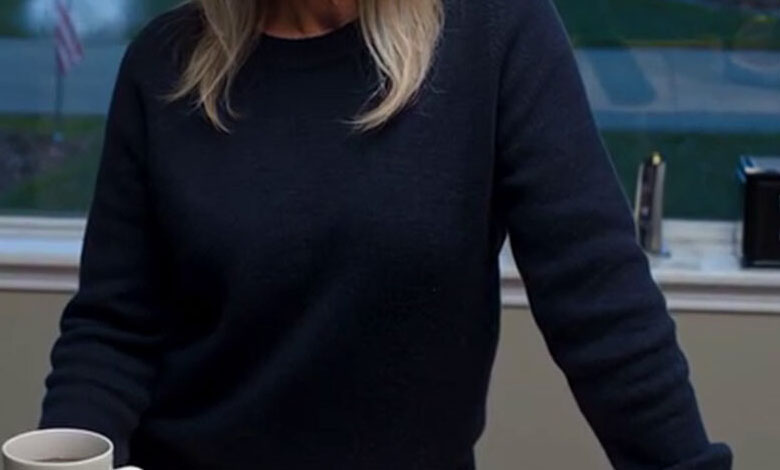
The funeral flowers had barely wilted when the phone calls began.
I was standing in my kitchen on a gray Tuesday morning, three weeks after we buried my husband, Russell, watching steam coil off a cup of coffee I couldn’t bring myself to drink. The ceramic mug—white with a faded red heart and the words World’s Best Grandma—had been a Christmas gift from my granddaughter, Kathleen, years ago. It felt foreign in my hands now, the way everything did: the house, my reflection in the hallway mirror, even my own voice when I answered the relentless calls from my children.
“Mom, we need to talk about the house.”
It was my son, Donald. His voice carried that familiar tone of barely contained impatience, the same one he’d used as a teenager when he wanted money for concert tickets or gas. Only now, at thirty-two, he wasn’t asking.
I set the mug down on the kitchen island without taking a sip and looked out through the window over the sink at our quiet Midwestern cul-de-sac. An American flag stirred lazily on the neighbor’s porch, the one Russell used to joke was more punctual than any alarm clock every Fourth of July.
“Good morning to you too, Donald,” I said.
“Don’t start with me, Mom. Lisa and I have been talking about your situation, and frankly, it’s not sustainable. That house is way too big for you alone. The mortgage payments—”
“There is no mortgage,” I said, my voice flat, purely factual.
Russell had paid it off five years earlier, but I’d never mentioned that to the children. They’d assumed, and I’d let them.
There was a pause, then a short laugh—sharp, dismissive, the same sharp edge Russell sometimes had in his voice, though my husband had usually wielded it with affection. Donald wielded it like a weapon.
“Mom, please,” he said. “Dad’s pension barely covers your medications. We all know the financial strain you’re under.”
I walked closer to the window above the sink. The garden Russell and I had tended for twenty-three years was beginning to blur at the edges: roses that needed pruning, an herb patch gone wild where basil and thyme tangled together. These had once been our weekend projects, little rituals of care; now they stood like monuments to everything I’d lost.
“Your concern is touching,” I said, catching my reflection in the glass. Gray hair that needed coloring. Lines around my mouth that had deepened in the past month. Sixty-three years of living etched into features that still surprised me in mirrors.
“Don’t be dramatic,” Donald said. “Darlene agrees with me. We think you should consider moving in with one of us.”
“Darlene agrees,” I repeated, turning away from the window. My daughter hadn’t called me once since the funeral. She hadn’t answered when I’d called her. “And when exactly did Darlene share this opinion?”
Another pause. I could almost see him running a hand through his thinning hair—a gesture he’d picked up from his father.
“We had dinner last night,” he said. “As a family. To discuss your options.”
Your options. Not our mother’s future. Not how we can help Mom through this. My options, as if I were a problem to be solved rather than a person to be supported.
“I see,” I said, opening the refrigerator out of habit, staring at the casserole dishes still stacked inside. Chicken and rice, lasagna, baked ziti. Offerings from well-meaning neighbors, church friends, and Russell’s old coworkers. I hadn’t had the appetite to touch any of them.
“And these options,” I asked, “include selling my home?”
“It makes financial sense,” he said. “You could help Lisa and me with our down payment. We’ve been looking at that colonial on Maple Street—you know, the one near the old elementary school. And Darlene could use some assistance with Kathleen’s college fund. It’s a win-win situation.”
I closed the refrigerator door with more force than necessary.
“A win-win situation,” I repeated.
“Mom, you know I didn’t mean it like that.”
But he had. Donald had always been transparent in his selfishness, even as a child. It was almost refreshing compared to Darlene’s subtle manipulations, the way my daughter had learned to ask for things sideways, making me feel guilty for not offering what she never had to ask for outright.
“What did you tell your sister about my finances?” I asked.
“Just the truth,” he said. “That Dad’s pension isn’t enough. That the house is too big for you to handle alone. That you’re probably struggling more than you’re letting on.”
The truth. As if he knew anything about my actual circumstances. As if any of them had bothered to ask about Russell’s pension in detail, the investments he’d made quietly over the years, or the modest inheritance from his mother that we’d saved and reinvested instead of spending.
I thought about the folder in Russell’s desk drawer, the one I’d found while sorting through his papers after the funeral. Bank statements. Investment portfolios. The deed to a small villa in Marbella that he’d purchased as a surprise for our retirement—a whitewashed house on a street called Calle de las Flores.
“A place where we can watch sunsets and drink wine without anyone asking us for anything,” he’d said, showing me photos on his tablet just six months before his heart attack. The pictures had looked like they belonged in a travel magazine, not in the life of a couple from a quiet American suburb.
“I’ll think about it,” I said finally.
“Mom, we’re not asking you to think about it,” he replied. “We’re telling you what needs to happen. Lisa’s cousin Gregory is in real estate. He already has a buyer looking for something exactly like your place. Cash offer. Quick closing. We could get this done in a month. Start packing your bags.”
My hand tightened on the phone.
“You found a buyer for my house,” I said slowly.
“We’re trying to help you, Mom,” he insisted. “The sooner you accept that this is the best solution for everyone, the easier this transition will be.”
Transition. As if grief were a corporate restructuring. As if dismantling thirty years of marriage and family memories could be reduced to paperwork and profit margins.
“And where exactly am I supposed to live during this ‘transition’?” I asked.
“Well, that’s what we wanted to discuss. Darlene’s got that finished basement, remember? With Kathleen away at college most of the year, there’s plenty of space. You’d have your own entrance, your own bathroom. It could work out perfectly.”
Darlene’s basement. The same basement that flooded every spring. The one where she stored Christmas decorations and exercise equipment she never used. The same basement where I’d been relegated during last year’s Thanksgiving dinner while the “real adults” ate at the dining room table upstairs.
“How generous of Darlene to offer,” I said.
“She’s excited about it, actually,” Donald said. “She thinks it could be good for both of you. You could help with Kathleen when she’s home, maybe do some cooking. You know how Darlene struggles with meal planning.”
Of course I knew. Darlene “struggled” with meal planning the same way she struggled with laundry, cleaning, and remembering to call her mother. She excelled at delegating those struggles to others—especially to the woman who had raised her to be self-sufficient.
“And Donald,” I asked, “what role do you play in this arrangement?”
“Lisa and I will handle the house sale, obviously. The paperwork, the negotiations. We’ll make sure you get a fair price.”
“Fair,” I said. I almost laughed. Donald’s definition of fairness had always tilted in his favor, like a rigged carnival game designed to separate fools from their money.
“I need to think about this,” I repeated.
“Mom, there’s nothing to think about,” he said. “Gregory’s client is serious. They want to close within the month.”
A month. They were giving me thirty days to dismantle the life Russell and I had built. Thirty days to surrender the home where we’d hosted their birthday parties and graduation celebrations, where we’d nursed them through chickenpox and heartbreak and the smaller crises of young adulthood. Thirty days to erase the house with the two-car garage and the American flag on the porch that our neighbors associated with our family.
“I said,” I repeated quietly, “I need to think about it.”
“Fine,” he said. “But don’t take too long. Good opportunities don’t wait around forever.”
The line went dead.
I stood in my kitchen, holding the phone, listening to a silence that suddenly seemed to echo through the entire house. Outside, a neighbor’s dog barked down the street. A car door slammed. Somewhere a delivery truck rumbled past. Life went on as usual in our neat little American subdivision, while mine felt like it was spinning out of control.
I walked down the familiar hallway to Russell’s study, to the oak desk where he’d paid bills and planned our future for more than two decades. The folder was still there, tucked beneath old tax returns and insurance policies.
I pulled it out and spread its contents across the desk’s polished surface. Bank statements showing balances that would make my children’s eyes widen. Investment portfolios that had weathered market storms and quietly grown. The deed to the villa in Spain, with glossy photos of whitewashed walls, blue shutters, and a small terrace overlooking the Mediterranean.
Russell had been a quiet man, methodical in his planning. He’d never boasted about money, never flaunted what we had.
“Let them think we’re struggling,” he’d said once when Donald came asking for yet another “loan” for some new business venture. “It builds character.”
I’d thought he was being cruel. Now I understood it as wisdom.
My phone buzzed on the desk. A text from Darlene.
Mom, Donald told me about the house. I know this is hard, but it’s really for the best. Kathleen is so excited about having Grandma closer. Can’t wait to discuss the details. Love you.
Kathleen. My granddaughter who had spent summers in this house, who had learned to bake chocolate chip cookies in this kitchen and to plant tomatoes in this very garden. The girl who called me every week during her first semester of college, homesick and overwhelmed, seeking comfort from the grandmother who always had time to listen.
When was the last time she’d called?
Two months ago? Three?
I scrolled through my messages, looking for recent texts or missed calls from her. Nothing since Christmas—just a group text thanking everyone for gifts.
No personal messages. No late-night calls about classes or roommates or boys. No questions about how I was coping without Russell.
The silence stretched around me, heavy with realization. They’d already moved on. All of them. Russell’s death had been an inconvenience to be managed, not a loss to be mourned together. And I… I was simply another inconvenience. Another problem requiring their efficient solution.
I closed the folder and slid it back into the drawer, but this time I knew exactly where it was. Then I walked upstairs to our bedroom, to the closet where Russell’s shirts still hung in a tidy row, smelling faintly of the aftershave he liked. I pulled a suitcase down from the top shelf.
It was time to start packing—but not the kind of packing Donald imagined.
The law office smelled of leather and old paper, like Russell’s study distilled and multiplied. On the wall behind the receptionist’s desk hung a framed print of the Manhattan skyline at dusk, all glass and steel and twilight, a reminder that even in a quiet Ohio town like ours, people still dreamed in big-city images.
I sat across from Connie West, the estate attorney Russell had chosen years ago. She was in her fifties, sharp-featured with silver-streaked hair and eyes that missed nothing.
“Mrs. Lawson,” she said, spreading several documents across the gleaming mahogany desk. “I have to say, this is highly unusual. Your husband was very specific about these contingencies, but I never expected we’d need to implement them.”
I smoothed the black dress I’d worn to Russell’s funeral—the only “formal” black dress I owned—and kept my voice steady.
“Russell always said I underestimated people’s capacity for selfishness,” I replied. “I’m beginning to think he was protecting me from a truth I wasn’t ready to see.”
Connie nodded. Her fingers traced the edge of a document stamped with the bank logo.
“The revocable trust he established gives you complete control over all assets,” she explained. “Your children were never named as beneficiaries of the real estate. Only of the life insurance policy. Everything else—the house, the investments, the property in Spain—belongs entirely to you.”
“And they don’t know about the property in Spain,” I said.
“According to your husband’s instructions, that information was to be shared only with you and only after the initial thirty-day period following his death,” Connie said. “He seemed to anticipate that your children might pressure you into hasty decisions immediately after the funeral.”
“Pressure,” I said. “That’s a polite word for what Donald has been trying to do.”
I thought of his voice on the phone, demanding rather than requesting, speaking to me as if I were an incompetent child instead of the woman who had raised him.
“The house sale they’ve arranged,” I asked. “Can it be stopped?”
Connie’s lips twitched into a thin, satisfied smile.
“You’re the sole owner,” she said. “No sale can proceed without your signature. If they’ve already found a buyer and made promises, they’re operating under false assumptions. Russell was very clear about protecting your autonomy.”
Something loosened in my chest, a knot I hadn’t realized I’d been carrying since the day of the funeral.
“And the Spanish property?” I asked.
“Also fully paid for and legally yours,” Connie said. “The property management company your husband contracted with sends monthly reports. The house has been maintained and is ready for occupancy whenever you choose.”
Whenever you choose. When was the last time anyone had spoken to me about choice instead of obligation?
Connie pulled out a cream-colored envelope and set it gently in front of me.
“There’s something else,” she said. “Your husband asked me to give you this letter exactly one month after his death. Today marks that date.”
My hands trembled as I opened the envelope. Russell’s careful, looping script filled the page. As I read, it felt as if his voice was in the room, woven into the sound of the air conditioner and the rustle of paper.
My dearest Michelle,
If you’re reading this, it means I’m gone and you’re dealing with the aftermath alone. I know our children—love them though we do—and I suspect they’re already circling like vultures, convinced they know what’s best for you.
They don’t.
You are not a burden to be managed or a problem to be solved. You are an intelligent, capable woman who raised two children, supported a husband through his career changes, and managed our household with grace for over thirty years. Don’t let them convince you otherwise.
The money and properties are yours to do with as you please. Keep them, sell them, give them away. It’s your choice. But make that choice based on what you want, not what others expect from you.
I’ve watched you sacrifice your own dreams for decades, always putting our family first. Now it’s time to put yourself first. Go to Spain if you want. Travel. Write that novel you always talked about. Do whatever brings you joy. The children will survive without your constant sacrifice. In fact, they might even grow stronger for it.
With all my love and faith in your strength,
Russell
P.S. The key to the Spanish house is in my desk drawer behind the photo of us in Venice. Mrs. Rodríguez next door has been caring for the garden and speaks excellent English.
I read the letter twice, my vision blurring at the edges. Russell had seen what I’d been too close to recognize: that our children had learned to view my love as a resource to be exploited rather than a gift to be cherished.
“Are you all right?” Connie asked gently.
I folded the letter and slid it back into its envelope, cradling it like something fragile and irreplaceable.
“I’m better than I’ve been in weeks,” I said. “What do I need to do to transfer the house deed into my name alone?”
Connie blinked.
“It’s already in your name alone,” she said. “Your husband removed the children from all property deeds three years ago, after Donald asked him to co-sign on that restaurant investment. Do you remember that?”
I did. I remembered the arguments at our kitchen table, Donald’s face flushed with anger when Russell refused to put our retirement savings on the line for his “sure thing.” At the time, I’d thought Russell was being harsh.
Now I saw it as something else: foresight.
“There’s one more thing,” Connie said, pulling out a smaller envelope. Inside was a bank card taped to a folded sheet of paper. “Your husband asked me to give you this as well. It’s connected to an account he opened last year. He called it your ‘independence fund.’”
The weight of the card felt strangely solid in my palm.
“How much is in it?” I asked.
“Fifty thousand dollars,” Connie said. “He deposited money every month, telling me it was for ‘when Michelle finally decides to live for herself.’”
Fifty thousand dollars. Money I’d never known existed. Saved from his pension and investment dividends while I’d carefully budgeted our household expenses, clipping coupons and checking grocery circulars like I always had.
Money not meant to make me feel safe—but free.
I left the law office with a briefcase full of documents and a clarity I hadn’t felt since before Russell’s heart attack. The house was mine. The Spanish villa was mine. The investments were mine. But most importantly, the choice of what to do with all of it was mine alone.
My phone rang just as I reached my car. Darlene’s name flashed across the screen.
“Mom, I’m so glad I caught you,” she said when I picked up. I could hear traffic in the background, the constant hum of life in the suburban strip-mall universe just beyond my quiet street. “I wanted to talk about the basement renovations. Lisa knows a contractor who could put in a kitchenette for you. Maybe a separate entrance. It would be perfect. Your own little apartment.”
I unlocked the car but stayed standing on the asphalt, the late-morning sun warming my back.
“How thoughtful,” I said.
“I know you’re probably worried about the cost,” she continued, “but Donald and I figured we could deduct it from the house sale proceeds. Think of it as an investment in your comfort.”
My comfort. Not my independence. Not my happiness. My comfort, as if I were an elderly pet being relocated to more manageable quarters.
“Darlene,” I said, “when was the last time you called me just to see how I was doing?”
A pause. “What do you mean?”
“I mean a phone call where you didn’t want something,” I said. “Where you asked about my day, my feelings, my plans. When you called because you missed talking to your mother.”
“Mom, that’s not fair,” she said. “I’ve been dealing with Kathleen’s college expenses, and you know how busy work has been.”
“Kathleen’s college expenses,” I repeated. I watched a minivan pull into the lot, a mother shepherding two kids in Little League uniforms toward a chain restaurant. America’s idea of convenience, everywhere you looked.
“Tell me about Kathleen’s expenses,” I said.
“Well, tuition is twenty-eight thousand a year,” Darlene said. “Plus room and board, books, her sorority fees—”
“Darlene,” I interrupted, “I’ve been sending Kathleen five hundred dollars every month since she started college. For two years. That’s twelve thousand dollars.”
Silence.
“Money that was supposed to help with her expenses,” I continued. “Money you never mentioned to Donald when you discussed my supposed financial struggles. Have you told Kathleen that I send that money?”
“She knows you help out,” Darlene said carefully.
“Does she know the amount?” I asked. “Does she know it comes from my pension, not from some college fund Russell left behind?”
“I don’t see why those details matter,” she said.
I closed my eyes, feeling something cold and clear settle in my stomach.
“She doesn’t know, does she?” I said softly. “She thinks her college expenses are covered by your hard work and sacrifice. She has no idea that her grandmother has been quietly funding her education.”
“Mom, you’re making this more complicated than it needs to be,” Darlene said.
“Am I?” I asked. “Or am I finally seeing how simple it actually is?”
I hung up and got into the car. My hands were shaking—but not from grief this time. From anger. Clean, bright anger that felt less like an explosion and more like waking up.
At home, I went straight to Russell’s desk and opened the drawer he’d mentioned in his letter. The key was exactly where he’d said it would be, small and brass, attached to a keychain with a tiny Spanish flag. Behind it was a photograph I’d forgotten existed: Russell and me in Venice on our twenty-fifth anniversary, both of us laughing at something the photographer had said. I looked younger in that photo, but not just because of smoother skin or darker hair. I looked younger because I looked unguarded. Happy.
My phone buzzed again. A text from Donald.
Mom, Gregory needs an answer by tomorrow. His client is getting impatient. Don’t mess this up for all of us.
Don’t mess this up for all of us.
I deleted the message without replying, opened my laptop on the kitchen table, and searched for the property management company’s website. It took me twenty minutes to find the right email address and another ten to compose a message.
Dear Mrs. Rodríguez,
My name is Michelle Lawson, and I am Russell’s widow. I believe you have been caring for our house on Calle de las Flores. I am planning to visit Spain very soon and would like to arrange to stay in the house for an extended period. Please let me know what preparations need to be made.
Thank you for your kindness in maintaining the property during this difficult time.
Sincerely,
Michelle Lawson
I hit send before I could talk myself out of it. Then I went upstairs and pulled the suitcase from my closet out onto the bed.
Before I packed anything for myself, I opened the closet in Donald’s old room and began filling boxes with his childhood trophies, his school papers, the baseball glove Russell had bought him for his tenth birthday. Everything that mattered from his time in this house, carefully wrapped and labeled.
I was halfway through packing up Darlene’s old room—her cheerleading medals, piano books, the framed photo from her high school graduation—when my phone rang again. An international number.
“Mrs. Lawson, this is Pilar Rodríguez,” a woman’s warm voice said when I answered. “I just received your email, and I am so sorry for your loss. Russell spoke of you often.”
Her English was accented but clear, each word wrapped in a kindness that made my throat tighten.
“Thank you, Mrs. Rodríguez,” I said. “I hope it’s not too much trouble, but I’m thinking about coming to Spain quite soon.”
“Oh, no trouble at all,” she said quickly. “The house is ready. I check on it every week, and the garden is beautiful. Russell would be so happy to know you were coming. When were you thinking to arrive?”
I looked around Darlene’s childhood bedroom, at the open boxes of memories I was packing for children who now saw me as an obstacle to their inheritance.
“Next week,” I said. “I’d like to come next week.”
The moving truck arrived at seven in the morning, just as Donald’s car pulled into my driveway. I watched from my bedroom window as my son climbed out, his face already arranged in that expression of barely controlled irritation I’d learned to recognize—and dread—years ago.
He was wearing his serious business suit, a pale yellow tie Lisa had picked out for his big interviews, and carrying a thick manila folder that I was sure contained house-sale documents and pre-printed signatures lines.
Perfect timing.
The movers were efficient, broad-shouldered men in navy T-shirts with the company’s name printed across the front, the kind of crew that spends its weekends shifting other people’s lives from one place to another all over our town. I’d hired them to collect the carefully packed boxes from Donald’s and Darlene’s old rooms, along with several pieces of furniture they’d both mentioned wanting “someday”: Russell’s leather armchair, the antique dining set I’d inherited from my mother, the upright piano Darlene had begged for as a child and then abandoned after six months of lessons.
“Ma’am, where do you want these boxes delivered?” the lead mover asked, glancing at his clipboard.
“The first set goes to 247 Maple Street,” I said, handing him Donald’s address in my careful handwriting. “The second set to 892 Pine Avenue. Ring the doorbell and tell them these are gifts from Michelle Lawson. Memories they’ll want to keep safe.”
He nodded professionally, but I caught the faint twitch of a smile at the corner of his mouth. Twenty years in the moving business had probably shown him more family drama than any therapist.
Donald’s sharp knock on the front door interrupted my instructions.
I opened it wearing the red dress Russell had always said brought out my eyes, my hair freshly styled from a little suburban salon down by the Target, looking nothing like the grieving, fragile widow my son expected to strong-arm.
“Mom, what the hell is going on?” Donald demanded, stepping inside. “Why is there a moving truck in your driveway?”
“Good morning, Donald,” I said calmly. “I’m having some things moved.”
He pushed past me into the foyer, his gaze darting to the stacks of boxes near the stairs, each clearly labeled with his or Darlene’s name.
“These are my things,” he said. “My childhood things. Why are you packing up my stuff?”
“I thought you’d want them,” I said. “Memories are precious, don’t you think?”
Color climbed from his collar up his neck, the same mottled red he used to get when he was caught in a lie as a teenager.
“Mom, we need to talk,” he said. “Gregory’s client is ready to make an offer. We need your signature today.”
I closed the door and leaned back against it, watching him pace my entryway like a caged animal. Family photos looked down at us from the walls—school pictures, Christmas mornings, Disney trips I’d scrimped and saved for.