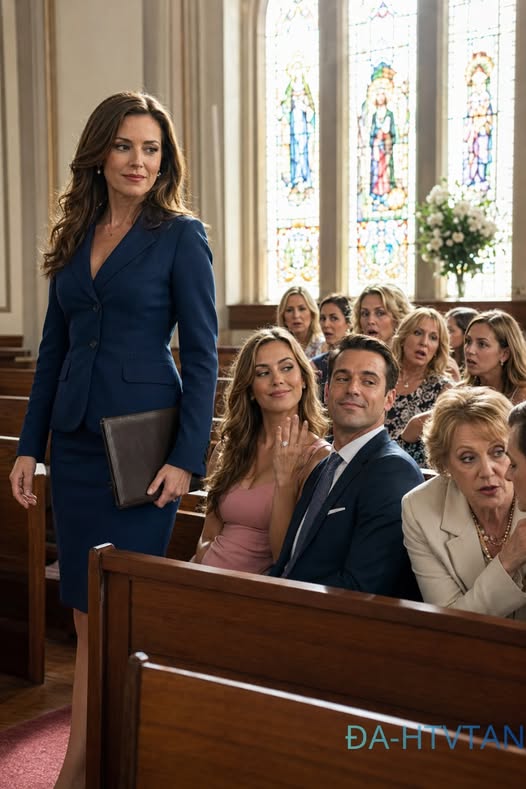
My husband let his mistress wear my engagement ring to church, and she made sure every woman in the third pew saw it. His mother whispered, “At least he looks happy,” like I was the embarrassing problem, not the wife being publicly erased. They expected tears, yelling, maybe a scene they could call unstable later. What they did not know was that the ring was already listed in a legal inventory, and I had stopped being emotional the moment it disappeared from my safe.
Part 1
The diamond flashed during prayer.
That was the part I remember most clearly. Not Graham’s profile turned toward the altar like he was some faithful husband. Not Sloane Mercer sitting beside him in ivory wool, her blonde bob tucked neatly behind one ear. Not even Marjorie Caldwell whispering behind them, “At least he looks happy.”
It was the ring.
My ring.
Three carats, old European cut, platinum setting, with a tiny emerald hidden under the crown where almost no one could see it unless they knew to look. My grandmother had worn it for forty-eight years. My mother wore it after that. Then Graham slid it onto my finger in the rain at The Spectator Hotel and promised he would spend the rest of his life proving he deserved it.
On that white Sunday morning at Grace Harbor Chapel in Charleston, he had let his mistress wear it to church.
She folded her hands like she was praying, but she tilted them just enough for the sunlight to catch the diamond beneath the stained-glass angel my grandmother had donated fifty years before.
It was a holy kind of cruelty.
I sat across the aisle in my cream Chanel dress, my hands resting in my lap, and kept my eyes closed even after the prayer ended. I could feel people noticing. Women always notice jewelry first, then betrayal. Men noticed too, but most of them stared straight ahead like pretending not to see something could make it disappear.
Graham had always loved an audience. He was born into one.
The Caldwells were old Charleston money, the kind of old that sounded impressive in newspaper articles and looked tired behind closed doors. Their name was on hospital wings and university plaques, but inside the family business, the walls were cracking. Their wealth still glittered from the street. Inside, it had termites.
When I married Graham, people called us Charleston royalty. They saw the house on the Battery, the fundraisers, the garden parties, the photographs in magazines. They did not know the crown was leased.
I was twenty-six when he proposed. My father had been gone eleven months, and my mother, severe and elegant in her grief, let Graham use my grandmother’s ring because I loved him.
Advertisements
“Your grandmother wore it for almost half a century,” she told me. “Let it begin again.”
The ring never belonged to Graham. It was listed in our prenuptial agreement under Schedule B: Separate Property of Evelyn Monroe Hart.
I should have known something was wrong the first time he called it “our diamond.”
At parties, when someone said, “Evelyn’s family ring is beautiful,” Graham would smile and correct them.
“Our engagement ring,” he’d say.
At first, I thought it was pride. Later, I understood it was hunger. He did not want to admire what was mine. He wanted people to forget it had ever belonged to me.
By the time Sloane Mercer entered our marriage, Graham and I had been together seven years and married six. She worked in brand strategy, which in Charleston meant she knew how to make other people’s money look like destiny.
Graham hired her to reimagine Caldwell Hospitality, his family’s boutique hotel group. Within three months, she was at board dinners. Within five, she was using our home gym. Within seven, she was leaving lipstick on wineglasses in my kitchen and smiling at me like she had misplaced something innocent.
I saw it.
Of course I saw it.
The late phone calls. The changed passwords. The sudden gym schedule. The way Graham touched the back of his neck whenever I walked into a room, like guilt had settled there and itched.
I said nothing because I wanted more than suspicion.
Suspicion makes a woman look emotional. Evidence makes her free.
So I became calm. I smiled at breakfast. I kissed Graham’s cheek at fundraisers. I sat beside him in photographs while a private investigator followed him from The Dewberry to a rented carriage house on Tradd Street.
I learned Sloane drank dirty martinis, tipped poorly, and told her friends Graham was “almost out.”
Almost out.
As if I were a locked room.
The week before church, my ring disappeared from the antique safe in my dressing room.
Graham stood in our closet beneath soft recessed lights, surrounded by silk dresses and hand-tailored lies, and told me I must have misplaced it.
“Evelyn,” he said, all patient concern, “you’ve been under stress.”
That was when I knew he had taken it. Not because the ring was gone. Because he sounded relieved.
I did not accuse him.
I filed a police report.
Then I called Julian Voss, my family’s attorney. My father used to say Julian was too handsome to be trusted and too competent to ignore. He had winter-gray eyes, silver at his temples, and the patience of a man who never moved before he had to.
“Do you want to retrieve the ring quietly?” he asked.
“No.”
“Do you know where it is?”
“Not yet.”
“Then we wait.”
On Sunday morning, Graham announced he was going to church with his mother. He had not gone voluntarily in eight months.
When I stepped into the foyer fastening pearl earrings, he looked genuinely startled.
“You’re coming?”
“Of course,” I said. “I wouldn’t miss it.”
His face tightened for one second before he smoothed it away. That was Graham’s greatest flaw. He believed discomfort, if ignored, would become obedience.
At Grace Harbor Chapel, every family had a pew and every pew had a memory. The Caldwells sat on the right, four rows from the front. My family had sat on the left until my grandmother died and my mother moved to Palm Beach, tired of nodding politely at women who had never forgiven her for being richer than their husbands.
I entered through the side door.
That was when I saw Sloane in the third pew, sitting beside my husband, my ring on her hand.
My humiliation did not come hot. It came cold. Clean, sharp, almost peaceful.
Pastor Whitcomb prayed for mercy, fidelity, and the sanctity of the home. Sloane bowed her head, then lifted her left hand slightly, letting the diamond flare in the morning light.
I kept my eyes closed.
Behind my lids, I saw my grandmother’s hands setting lemon bars on a silver tray. My mother wiping her tears after my father’s funeral. Graham on one knee with rain in his hair, promising forever with a ring he had no right to give twice.
When the final hymn ended, no one moved right away. The whole chapel seemed to hold its breath.
I stood.
The aisle looked longer than it had when I walked down it as a bride. This time there were no flowers, no music swelling, no proud husband waiting.
Only witnesses.
Sloane looked up with an expression she had clearly rehearsed. Soft. Wounded. Victorious.
“Evelyn,” she said, like we were friends meeting for brunch.
I ignored her and looked at Pastor Whitcomb.
“Pastor,” I said, my voice gentle enough to make people lean closer, “would you mind witnessing the return of stolen property?”
The chapel went so quiet I could hear old wood settling beneath polished shoes.
Graham stood so fast the hymnal fell from his lap.
“Evelyn,” he hissed.
I looked at Sloane’s hand.
“Take off my ring.”
Her smile shook. “Graham gave this to me.”
“No,” I said. “Graham stole it from a safe.”
Marjorie Caldwell’s powdered face went pale.
“Let’s not be vulgar,” she snapped.
I smiled at her.
“Vulgar was bringing a mistress to church in a dead woman’s diamond.”
Graham grabbed my elbow. I looked down at his hand until he let go.
Pastor Whitcomb stepped closer, eyes moving from me to the ring to Graham’s frozen face.
“Mrs. Caldwell,” he said quietly, “is there documentation?”
“There is.”
Through the open chapel doors, Julian Voss appeared in a charcoal overcoat, holding a leather folio. Behind him stood Officer Ramirez from the Charleston Police Department, polite, composed, and already tired of rich people behaving badly.
Julian opened the folio.
“The ring is listed in Mrs. Caldwell’s prenuptial inventory, Schedule B, item four,” he said. “It was reported stolen last Tuesday. We have the insurance appraisal, photographs, safe access logs, and family ownership documents.”
Sloane’s hand began to tremble.
Graham whispered, “Evelyn, don’t do this.”
I looked at the man I had loved, the boy inside the man who still believed charm could outrun consequence.
“I didn’t do this,” I said. “I documented it.”
Sloane removed the ring.
It took her three tries.
She placed it in Julian’s gloved hand. He sealed it in an evidence pouch with the care of a man preserving both a crown jewel and a crime scene.
I turned to Pastor Whitcomb.
“Thank you,” I said. “Please continue your Sunday.”
Then I walked out while every head followed me, and outside the chapel, before I even reached the black town car, my phone began lighting up with the video.
Part 2
By noon, the clip had spread across Charleston society pages, women’s Facebook groups, TikTok accounts with names like Southern Scandal Daily, and at least one divorce attorney’s Instagram story.
The title was simple.
WIFE MAKES MISTRESS RETURN STOLEN RING IN CHURCH.
By dinner, strangers had opinions about my dress, my voice, my marriage, my posture, my lack of tears, and whether Pastor Whitcomb should have stopped me.
By midnight, I had become a symbol.
Wronged wives called me elegant. Mistresses called me bitter. Men called me dramatic, which is what men call women when the evidence is organized.
Graham called forty-seven times.
I answered none of them.
I spent the night in the penthouse suite of The Hartfield, a hotel my family owned on East Bay Street through a holding company Graham had never bothered to understand. Rain tapped against the windows. Below, Charleston glittered in wet gold and black iron.
Julian sat across from me at a marble table with coffee, legal pads, and a folder labeled CALDWELL MATTER. He had taken off his tie, which told me the day had been serious.
“The ring is secure,” he said. “Officer Ramirez filed supplemental documentation. Pastor Whitcomb signed as witness. So did three parishioners.”
“Which three?”
“Mrs. Abigail Fontenot, Judge Merriweather’s widow, and unfortunately, Bitsy Harlow.”
I almost laughed. Bitsy Harlow had never kept a secret in her life. By morning, my ring would have its own obituary.
Julian slid another folder toward me.
“Now we discuss the rest.”
The rest.
There is always a rest.
Infidelity is rarely just bodies in borrowed beds. It is money. It is timing. It is lies that require signatures.
For six months, I had been building a cathedral out of paper. Credit card statements. Wire transfers. Security footage. Hotel invoices. Emails Graham thought had been erased. Photographs of him kissing Sloane behind a members-only club in Savannah. Text messages where he promised her my house, my ring, my life.
The most important evidence came from his own arrogance.
Graham had used a Caldwell Hospitality account to pay for Sloane’s apartment, her Range Rover lease, her consulting bonuses, and three pieces of jewelry he described in company records as client retention gifts.
He had also moved $2.4 million from an operating line of credit into a shell entity called Mercer Lane Creative.
Sloane was the sole owner.
“Does he know we have this?” I asked.
“Not yet.”
“Good.”
Julian watched me carefully. “There’s more.”
The room seemed to shrink.
He opened a third folder. Inside was a photocopy of a document I recognized but had not signed.
A postnuptial amendment.
My name appeared at the bottom.
My signature, or something meant to resemble it.
The amendment waived my claim to any appreciation in Caldwell Hospitality, released Graham from reimbursement obligations related to marital misuse of funds, and granted him continued residence in our Battery mansion if we separated.
It was dated two months earlier.
I stared at the forged signature until it stopped looking like my name and started looking like what it was: a doorway Graham had tried to lock from the inside.
“Who notarized it?” I asked.
“Lena Cross.”
Graham’s executive assistant. A woman with three children, a mortgage, and a habit of crying in parking garages when she thought no one could see.
“Did she know it was forged?”
Julian paused. “I think she knew enough to be frightened.”
I looked out at the harbor, black and jeweled under the rain.
“Offer her protection,” I said. “Employment if she needs it. Separate legal counsel.”
Julian’s expression softened by one degree.
“You’re still kind.”
“No,” I said. “I’m precise.”
There is a difference. Kindness gives without strategy. Precision saves the innocent so the guilty cannot hide behind them.
The next morning, I returned to the Battery house.
Graham was waiting in the foyer under the chandelier my mother had given us as a wedding gift. He looked exhausted, furious, and handsome in the useless way expensive men often are when they realize beauty is not a defense.
“You humiliated me,” he said.
I removed my gloves.
“You brought your mistress to church wearing my stolen ring.”
“You could have handled it privately.”
“You could have committed adultery privately.”
His mouth tightened.
Behind him, Marjorie descended the staircase like a queen arriving at an execution she expected to enjoy.
“Evelyn,” she said, “this has gone far enough.”
I glanced at the portraits lining the wall. Caldwell men in oil paint. Caldwell wives in pearls. None of them smiling.
“I agree.”
“Then you will make a statement,” Marjorie said. “You will say there was a misunderstanding. You will apologize to Sloane for implying theft.”
I let the silence breathe.
Then I laughed once.
Small. Soft. Fatal.
Marjorie’s eyes widened because she had never heard me laugh at her before.
“Marjorie,” I said, “your son forged my signature, stole my heirloom, and financed his mistress with company money. The only statement I’m making will be filed with the court.”
Graham flinched.
There it was. Recognition.
He knew about the ring. He knew about the money. But the forged signature had been his secret crown.
“Who told you that?” he demanded.
“Paperwork.”
“Evelyn, listen to me.” He stepped closer, lowering his voice into the tone he used when he wanted people to think panic was concern. “If Caldwell Hospitality goes down, hundreds of people lose jobs. Families. Staff. You want that on your conscience?”
“No one is losing their job because you bought your girlfriend a lifestyle,” I said.
Marjorie stiffened. “She is not his girlfriend.”
“No,” I said. “She is evidence.”
Then all three of our phones buzzed.
Julian had filed the emergency motion.
The court froze questionable transfers from Caldwell Hospitality. The forged postnuptial agreement was challenged. A preservation order was issued for electronic communications. Graham’s access to certain accounts was temporarily restricted.
For the first time in our marriage, he looked at me and saw the woman he had been living with instead of the wife he had invented for his convenience.
“What do you want?” he asked.
“My ring,” I said. “My name. My money. And the truth.”
Over the next few days, Graham moved through every predictable stage.
First, charm. White roses arrived at The Hartfield with a note.
Evie, don’t let the worst day define us.
I sent them to the lobby and told the concierge to offer them to anniversary guests.
Then guilt.
You know my father’s company is all I have.
I replied: You should have protected it.
Then anger.
You think you can destroy me and walk away clean?
I replied: Watch me.
That message became an exhibit.
Sloane tried performance. She posted a photo of herself in a black dress, bare left hand pressed over her heart, with a caption about healing.
The internet ate her alive. Not because people are moral. People are rarely moral in groups. They ate her alive because she made the mistake of looking smug while exposed.
By Friday, Lena Cross called Julian.
We met her in a private conference room above a law office on Broad Street. She arrived in a beige coat with red eyes, clutching a folder to her chest like it could keep her upright.
“I didn’t want to notarize it,” she said before she even sat down.
Julian placed a glass of water in front of her.
“Tell us what happened.”
Lena looked at me.
“I’m sorry, Mrs. Caldwell.”
“Tell the truth,” I said. “That’s enough.”
Her hands shook as she opened the folder. Graham had asked her to notarize my signature on the postnuptial amendment after telling her I had signed it at home and forgotten to have it witnessed. When she hesitated, he reminded her that her oldest son’s internship at Caldwell Hospitality could disappear.
Then he handed her a bonus check.
“I knew it was wrong,” she whispered. “But I didn’t know what to do.”
“Did Sloane know?” Julian asked.
Lena nodded.
“She printed the document.”
There was the thread.
We pulled.
Emails showed Sloane suggesting language for the forged postnup. Texts showed Graham promising to “handle Evie financially” before filing for divorce after the spring gala.
The spring gala was Caldwell Hospitality’s grandest annual performance. Black tie, champagne tower, orchestra, donors, press, local politicians, influencers, and a silent auction full of vacations donated by people who needed tax deductions.
Graham had planned to introduce Sloane publicly that night.
Not as a mistress.
As his future.
Sloane expected me to be absent, buried under scandal and lawyers.
Instead, I accepted the invitation.
The gala was held at The Alcott, Caldwell Hospitality’s flagship hotel on Meeting Street. It had marble floors, velvet banquettes, and a rooftop terrace overlooking a city built by men who believed beauty could excuse anything.
I wore black silk.
No necklace. No ring. Hair pulled back. Red lipstick sharp enough to warn strangers.
When I walked into the ballroom, conversations died in beautiful little waves.
Graham stood near the champagne tower with Sloane on his arm. She wore emerald satin. Around her neck hung a diamond pendant Graham had purchased with company money and disguised as vendor appreciation.
Marjorie saw me first.
“Evelyn,” she said, her smile freezing. “How brave.”
“How bankrupt,” I replied.
Her face collapsed for one second.
Enough.
Graham moved toward me. “You shouldn’t be here.”
“This is a Caldwell event.”
“Exactly.”
I smiled.
He did not yet know.
At nine o’clock, Graham climbed onto the stage. He was magnificent under pressure, I will give him that. He smiled like a man whose house was not burning, thanked donors, praised legacy, and spoke of new beginnings.
Sloane watched him with shining eyes.
The mistress wanted blessing. She wanted the room to witness her promotion from secret to destiny.
Graham gestured for her to join him.
That was when Julian entered through the side doors with two men in dark suits and a woman carrying a tablet.
Graham stopped mid-sentence.
The orchestra faltered.
Julian did not take the stage. He didn’t need to. The hotel manager, pale and sweating, handed him the microphone after reading the document Julian placed in his hand.
“Ladies and gentlemen,” Julian said, calm as winter, “forgive the interruption. My name is Julian Voss. I represent Hart Legacy Trust and its affiliated holding entities. Effective at 5:00 p.m. today, Hart Legacy Trust exercised its rights under the secured debt agreements of Caldwell Hospitality Group.”
Graham’s face emptied.
Sloane whispered, “What does that mean?”
I looked at her.
“It means I own the room.”
Part 3
Julian continued, his voice carrying cleanly through the ballroom.
“Due to material default, fraudulent transfers, and breach of financial covenants, operational control of The Alcott Hotel and associated Caldwell properties has transferred to the secured creditor pending restructuring. Staff positions remain protected. Vendor contracts remain honored. Donor funds remain untouched.”
Confusion rippled through the room and swelled into noise.
Graham stepped off the stage and came straight toward me.
“What did you do?”
“What your grandfather should have done,” I said. “I read the debt.”
Three years earlier, Caldwell Hospitality had needed capital. Graham had been too proud to come to me openly, so he chased lenders through private channels until he accepted a rescue package from an anonymous investment vehicle.
Ash Harbor Holdings.
He never asked who stood behind it.
He saw money and assumed it belonged to a man.
Ash Harbor Holdings belonged to Hart Legacy Trust.
Hart Legacy Trust belonged to me.
My family had saved his company while allowing him to keep his pride. I had done it because I loved him. Because I believed marriage meant protecting one another’s weaknesses from the world.
But love does not require a woman to finance her own betrayal.
The loan agreements were strict. No fraudulent transfers. No misuse of operating capital. No undisclosed related-party payments. No material reputational harm tied to executive misconduct.
Graham had violated all of it.
For Sloane’s apartment. For her car. For her jewelry. For a forged document meant to erase me.
He had handed me the keys to his kingdom one receipt at a time.
Sloane stepped away from him as if scandal were contagious.
“You set me up,” Graham said.
“No,” I said. “I waited for you to tell the truth.”
“You bought my company.”
“I saved your company,” I corrected. “Then you used it like a wallet with a mistress attached.”
Bitsy Harlow, bless her incurable soul, was filming from behind a floral arrangement.
Julian handed the microphone back to the manager, then turned to Graham.
“You’ve been served.”
One of the men in dark suits stepped forward with an envelope. Divorce petition. Civil claims. Injunction. Notice of control transfer. Evidence preservation order.
Paperwork, stacked like bricks.
Sloane tried to leave.
The woman with the tablet stopped her.
“Ms. Mercer,” she said, “you’ve also been served.”
Sloane looked at Graham with the dawning horror of a woman realizing she had not stolen a prince.
She had climbed into a lawsuit.
By morning, the gala video had outrun the church video.
The internet loves a ring. It worships a takeover.
My personal favorite caption came from a woman in Atlanta: This is why you never underestimate a quiet wife in good tailoring.
Graham’s publicist begged for a joint statement. Julian declined.
Marjorie called my mother in Palm Beach. My mother listened for forty-three seconds and said, “Marjorie, I warned you not to mistake my daughter’s manners for permission.”
Then she hung up.
I loved her for that.
The legal process moved faster than gossip and slower than pain.
Depositions began. Graham arrived in a navy suit with the expression of a man who expected the room to remember his childhood trophies. Sloane arrived separately, wearing sunglasses indoors.
At first, she played innocent.
Graham told me he was separated.
Graham said Evelyn knew.
Graham gave me the ring as a promise.
Then Julian projected the church video onto the conference room screen. Sloane watched herself fold her hands beneath stained glass, smiling at a wife she knew was present.
“Did you believe Mrs. Caldwell consented to you wearing her engagement ring in church?” Julian asked.
Sloane’s lips parted.
“No.”
“Did you know the ring was Mrs. Caldwell’s separate property?”
“I knew it was a family ring.”
“Whose family?”
She looked down.
“Evelyn’s.”
One by one, the pretty lies lost oxygen.
Lena testified. The forensic accountant testified. The appraiser testified that my ring bore a microscopic laser inscription matching my grandmother’s insurance file. The jeweler testified that Graham brought it in for cleaning two days after it disappeared from my safe and asked whether the setting could be resized.
“To what size?” Julian asked.
The jeweler glanced toward Sloane.
“Six and a half.”
My ring finger was a five.
Sloane’s was a six and a half.
There are measurements for every betrayal if you know where to look.
The day Pastor Whitcomb testified, Graham tried to settle.
I sat across from him in a private mediation room at the courthouse. He looked smaller under fluorescent lights. Expensive men often do.
“I loved you,” he said.
I believed him.
That was the worst part.
He had loved me in the way weak people love useful things. He loved my beauty when it reflected well on him, my money when it rescued him, my silence when it protected him, my family name when it opened doors.
He loved me like property.
But property can be reclaimed.
“I know,” I said.
His eyes filled. For a moment, I saw the man from the rooftop bar, rain in his hair, hope in his hands, holding an old ring he did not deserve.
“I made mistakes,” he said.
“No, Graham. You made plans.”
He flinched.
“What will it take for you to stop?” he asked.
I looked at Julian. He said nothing. That was the rule. He advised. I chose.
“You will admit the affair. You will admit the misuse of funds. You will withdraw the forged postnuptial agreement and cooperate with the investigation into Sloane’s company. You will vacate the Battery house within thirty days. You will resign from operational control of Caldwell Hospitality.”
His face hardened.
“That’s everything.”
“No,” I said. “That’s consequence.”
Marjorie, who had insisted on attending, finally snapped.
“You vindictive little—”
“Careful,” Julian said.
Just one word.
She stopped.
I turned to her.
“For six years, I hosted your fundraisers, protected your son’s reputation, refinanced your family business, and smiled while you reminded me that Caldwells do not air dirty laundry.”
Her jaw worked.
“So I had it dry-cleaned,” I said. “Then I filed it.”
Graham accepted most terms by the end of the week.
Sloane did not.
She believed she could fight. That ended when Mercer Lane Creative drew the wrong kind of attention. The diamond pendant disappeared from her Instagram. The Range Rover disappeared from her driveway. Her friends disappeared first, of course. Friends built on access rarely survive subpoenas.
But Sloane had one final card.
She sold an interview.
A streaming gossip show filmed her in soft lighting, wearing beige cashmere and wounded eyes. She claimed Graham had manipulated her and I had bullied her. She called me cold, calculating, and obsessed with punishment.
“She never loved him,” Sloane said. “She loved control.”
For a day, the internet tilted.
There is always a moment when people ask whether a woman’s composure means she is cruel.
I said nothing.
Julian advised silence. My mother advised diamonds.
Then the final twist arrived on its own, wrapped in a padded envelope at my hotel suite.
No return address.
Inside was a flash drive and a handwritten note.
Mrs. Caldwell,
I thought you should know he was going to do worse.
—L
Lena.
The flash drive contained security footage from Graham’s office. Two months before the church scene, Sloane and Graham sat together at his desk, reviewing the forged postnuptial amendment.
Their voices were clear.
Sloane said, “Once she signs, you can file after the gala.”
Graham said, “She won’t sign.”
Sloane laughed. “Then make it look like she did.”
Graham said, “And the ring?”
Sloane held up her left hand, admiring the empty space.
“I want the real one. Not some divorcee consolation prize.”
Graham kissed her knuckles.
“You’ll have it by Easter.”
By Easter.
The church service had not been impulse.
It had been rehearsal.
Sloane had wanted my ring in front of God and Charleston because she believed public display could make theft feel legitimate. She wanted people to see it, accept it, bless it.
I watched the video twice.
Then I sent it to Julian.
Sloane’s interview vanished from the gossip show’s website within twelve hours.
The final hearing took place on a rainy Thursday in May. Charleston rain is theatrical. It glosses the streets, darkens the brick, and makes every woman arriving at court look like she is walking through the last scene of a film.
I wore navy.
Not black.
Mourning was over.
The courtroom was full, though no one admitted they had come for entertainment. They called it support, concern, civic interest. Bitsy Harlow sat in the back row pretending to read a church bulletin.
Graham arrived with his attorney and no mother. Sloane arrived late, her blonde bob grown out, her confidence worn thin.
The proceedings were cleaner than people expected.
That is the thing about destruction supported by documentation. It does not need shouting. It simply arrives, page after page, until denial has nowhere elegant left to stand.
The judge validated the prenuptial agreement. The forged postnuptial amendment was withdrawn and referred for further review. The ring was confirmed as my separate property. Graham accepted responsibility for specific financial misconduct. Sloane and Mercer Lane Creative remained subject to separate civil claims.
Caldwell Hospitality entered restructuring under Hart Legacy Trust control.
No employees lost their jobs.
Three executives resigned.
The hotel group survived, which angered Graham more than if I had destroyed it. Ruin would have let him call me reckless. Preservation made him unnecessary.
Near the end, Graham asked to speak. His attorney touched his arm, but Graham stood anyway.
“Your Honor,” he said, voice rough, “I have done things I regret. But I don’t want the record to suggest that my marriage was only financial. I loved my wife.”
The courtroom went still.
He looked at me.
“I still do.”
It was a beautiful performance.
Once, it might have killed me.
The judge allowed me to respond, so I rose.
“I believe Graham loved what my love allowed him to become,” I said. “I believe he loved the rooms I made possible, the reputation I protected, the history I shared, and the forgiveness he assumed would always be waiting.”
My voice did not shake.
“But love is not proven by what a man accepts. It is proven by what he refuses to betray.”
Graham looked down.
“He took a ring from my safe and placed it on another woman’s hand in a church built partly by my grandmother’s generosity. He forged my name to erase my rights. He used company funds to finance a fantasy while asking me to preserve his reality. I am not here because my heart was broken. I am here because he broke contracts, laws, and trust.”
The ruling was entered before lunch.
Outside the courthouse, rain had stopped. Reporters waited beneath umbrellas.
“Mrs. Caldwell,” one called, “how does it feel to win?”
I paused.
The question was wrong. Winning sounds bright. This felt clean.
“It feels documented,” I said.
That clip went viral too.
Weeks passed. The Battery house sold privately to a family with three children and no interest in ghosts. I kept my grandmother’s chandelier and donated the dining room table to Grace Harbor Chapel for its community hall.
Graham moved into a condo in Atlanta and began consulting for a hospitality firm that did not put his name on the website. Sloane moved to Nashville, rebranded herself as a resilience strategist, and blocked half the Southeast.
Marjorie sent one note on heavy stationery.
Evelyn,
I was cruel because I was afraid. I taught my son pride and called it dignity. I am sorry.
I read it once.
Then I placed it in a drawer.
Forgiveness, like jewelry, should never be worn because someone else demands to see it.
In June, at the reopening of The Alcott, I wore white. Not bridal white. Beginning white.
Hart Legacy Trust had renovated the rooftop garden, replaced the old bar, raised staff wages, and renamed the presidential suite after my grandmother, Beatrice Monroe Hart.
Julian stood beside me near the terrace railing with two glasses of champagne. He had been my attorney, my strategist, my witness. Nothing more. Not while the war was active. Not while pain could dress itself up as desire.
But the filings were complete. The ring was back in my safe. The woman I had been was not coming back, and the woman I had become did not want to walk alone forever just to prove she could.
Julian handed me a slim envelope.
“There’s one document we never discussed,” he said.
For one wild second, I thought life had become cruel enough to offer another lawsuit.
Instead, inside was a deed transfer confirmation.
Grace Harbor Chapel.
Not the congregation. Not the faith. The land beneath it.
My grandmother’s trust had held a reversionary interest dating back decades. When the chapel’s old property board dissolved, the land had quietly returned to Hart Legacy Trust.
Julian’s eyes warmed.
“Technically,” he said, “when Sloane wore your ring in that church, she was trespassing on your land.”
For the first time in months, I laughed.
A real one.
A week later, I returned to Grace Harbor Chapel alone. No cameras. No pearls watching from pews. No mistress. No husband. No mother-in-law whispering behind a hymnal.
Pastor Whitcomb met me near the altar.
“I wondered if you would come back,” he said.
“So did I.”
Sunlight spilled through the stained-glass angel, the same light that had once struck my stolen diamond on another woman’s hand.
This time, my ring rested on my finger.
Not as a symbol of marriage.
As evidence of survival.
I sat in the third pew and let myself feel everything I had postponed. The humiliation. The fury. The grief. The strange mercy of being freed by the cruelty meant to break me.
Outside, children laughed in the courtyard where my donated table would soon be covered with lemonade and paper plates. The chapel was starting a legal aid fund for women leaving dangerous marriages. Hart Legacy Trust had made the first contribution anonymously, though I suspected Bitsy Harlow would solve that mystery by supper.
I did not mind.
Some secrets deserve air.
Before I left, I lit one candle.
Not for Graham.
Not for Sloane.
For the woman who sat through prayer while her heart was being displayed on another woman’s finger and still had the discipline to wait until the hymn ended.
At the chapel door, I looked back once.
The aisle no longer seemed long.
It looked like a path.
People later asked whether I regretted making the church scene public.
I never knew how to answer without laughing.
I did not make it public.
Graham did.
He chose the church. He chose the pew. He chose the mistress. He chose the ring. He chose to confuse my grace with permission and my quiet with absence.
All I did was arrive with the truth.
Some women pray for a sign. Some women wait for an apology. Some women burn the whole story down.
I chose a cleaner fire.
She prayed with my ring.
I answered with paperwork.
The End