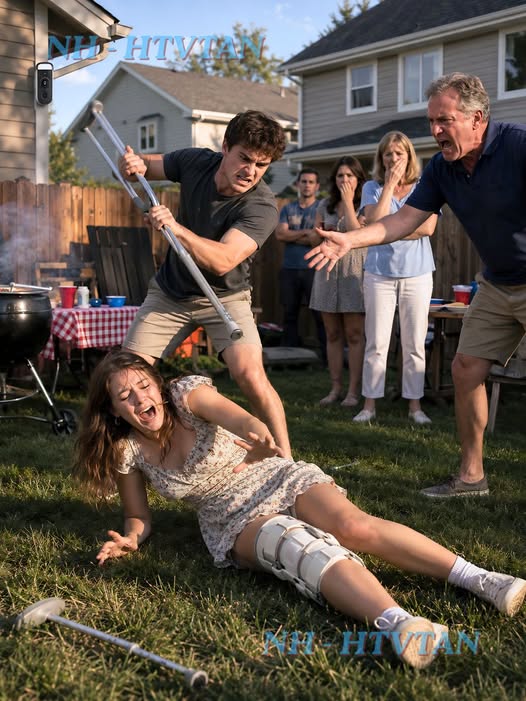
The noise from our family barbecue always had a certain rhythm to it. A steady blend of clattering plates overdone laughter and the smell of charcoal drifting across the backyard. But that afternoon, the rhythm changed. It was subtle at first, like a current shifting beneath the still water. A few heads turned, a few voices paused midsentence.
I felt the shift before I understood it. I was making my way across the grass on my crutch, moving slower than I wanted, trying not to show how much pressure on my leg made my vision tighten at the edges. The yard was crowded with neighbors, cousins, co-workers my father liked to impress, and the usual group of people my parents invited to maintain an image.
They all seemed louder and brighter than I could handle that day, but I kept going cuz staying home had not been an option. My mother told me it would look bad if I did not show up. She always cared more about appearances than well-being. I was just a few feet from the picnic tables when I heard Evan’s footsteps, heavy, sharp, purposeful.
Before the sound could fully register, his hand shot forward and yanked my crutch out from under me. My body lurched sideways, the world tilting, and then the ground punched up against me. The fall knocked the breath out of my lungs so violently that for a moment I could not inhale at all.
My cheek mashed into the grass, the blades scratching my skin, and pain flared through my leg like a brand pressed against my bone. I tried to push up with my arms, but the pain only intensified. Above me, Evan’s voice cut through the backyard chatter with a force cold enough to steal everything else. “You think you can just ignore me? You owe me money, Mara.
You hear me? You owe me.” His words were so loud the entire yard seemed to turn toward us. People froze in mid-motion paper plates suspended in the air. Cups stopped halfway to lips. I could hear the sudden eerie hush that only happens when something crosses the line between normal family tension and something darker.
I tried to speak, but my voice came out thin. Evan, please give it back. Please. He laughed sharp and mocking and then raised the crutch above his shoulder like he was about to swing a bat. Before I could pull my injured leg out of the way, the metal slammed down across my shin. A shock of pain so intense it felt electric tore through me.
The sound that left my mouth did not feel like mine. I heard someone gasp behind me and another voice say quietly, “Oh my god.” But no one moved. Evan hit me again and again. The blows landed with a sickening combination of metal and bone. Each impact thutting through the grass and into my body. I curled in on myself, my hands clawing at the ground, desperate to pull my leg out of reach.
But every tiny movement only triggered another jolt of pain. The world was shrinking into the rhythm of the strikes and the pounding of my heartbeat in my ears. I felt the heat of my father’s grill behind me before I heard his voice. My father did not run toward us. He did not drop the spatula or the beer in his hand. He just looked up, took in the sight of his son, beating me with my own crutch, and shouted with a voice full of irritation rather than concern. Hit harder.
Maybe she’ll finally stop faking. A few people flinched at his words, their faces twisting in disbelief. But when one woman murmured, “This is wrong.” My father snapped back without hesitation. “Mind your business.” My chest tightened in a way that had nothing to do with pain. This was not new. This was a pattern.
A lifetime of being undermined, dismissed, overshadowed, invisible. Evan raised the crutch again. I squeezed my eyes shut, bracing for the next impact. My breaths came in short, panicked bursts, each inhale scraping against my throat. But just before the strike came down, something flickered at the edge of my vision.
A small pulsing red light from the wooden fence at the back of the yard. At first, I thought I was imagining it, but then I recognized the glow. The neighbors ring camera recording. The realization cracked something inside me. Not in pain, but in a desperate tiny spark of hope. Someone was witnessing this. Something was capturing the truth I had spent years trying to explain.
As I lay in the grass dirt on my face, pain burning through my leg, surrounded by people who watched but did nothing. I felt the weight of my own invisibility settle over me like a second skin. And in that moment, I understood something I had never been willing to admit. That day I learned pain is not the worst thing. Being invisible is.
I was not born invisible, but I learned early how easy it was for a child to disappear in her own home when her existence did not fit the story her parents wanted to tell. Growing up, I spent years trying to understand what made Evan the center of everything and what made me somehow an afterthought. People outside the family always said he had charisma, that he was bright, energetic, full of potential.
They said I was quiet, responsible, mature for my age. They never understood that those words were just polite ways to describe a child who had learned that her feelings were inconvenient and her needs were a burden. My earliest memory of the imbalance was not dramatic. It was a Saturday morning when I was six, playing in the living room with a set of ceramic figurines my aunt had given me.
One slipped from my hand and cracked against the coffee table. I froze. My mother rushed in when she heard the noise, and before I could explain, Evan pointed at me and said she did it because she is jealous I have nicer toys. I tried to protest tears welling up, but my father told me to apologize to Evan for upsetting him.
I remember staring at the crack on the figurine and wondering how a lie could weigh more than the truth simply because it came from the child they loved more. Moments like that happened again and again, small and sharp like paper cuts. Whenever something went wrong, someone forgot their homework, someone spilled juice on the carpet, someone broke a lamp, I was the apology, the explanation, the responsible one who should have prevented it.
My mother used to say, “You are the older one. You understand more. You have to be patient with Evan.” Except I was not the older one. Evan was. That did not matter. He fit the mold they wanted. I did not. I became the child who stood in the background of every photograph, always slightly turned, always slightly out of focus. At school, I got good grades, joined clubs, won awards, not because I wanted to be exceptional, but because I hoped achievements might finally make my parents look at me with pride instead of expectation. When I brought home