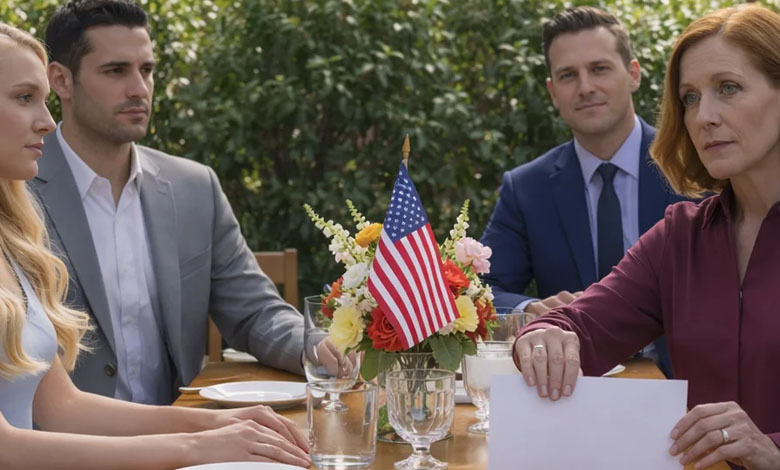
The quiet in my kitchen had a way of making memories louder.
At the end of a long cul-de-sac outside Columbus, Ohio, my little ranch house sat the way it always had, modest and square-shouldered, with the same worn welcome mat and the same dent in the screen door where Emma once tried to push a bicycle through without turning the handlebars. Even the air had a familiar feel in late afternoon, the kind of soft summer warmth that clings to your forearms when you stand near a window.
I was at the sink, rinsing out a coffee mug that still smelled faintly of dark roast, when I noticed the neighbor’s American flag across the street. It hung heavy in the still air, catching the sunlight so the red looked deeper than it did at noon, like it had soaked up all the day’s heat.
That was when Emma walked in.
I hadn’t heard her car. I hadn’t heard the front door, either, which meant she’d used her old key like she always did, even though she didn’t live here anymore. The sound of her shoes on the kitchen floor stopped me. I turned, still holding the mug, water running over my fingers.
She stood there in her wedding dress.
Not the full veil and train, not the whole grand production from three days ago, but still in that white fabric that made her look like she’d stepped straight out of the photographs. The dress was slightly wrinkled at the hip, like she’d sat down in it too long, and her hair was pulled back in a simple clip, a few loose strands curling around her cheeks.
But her smile was bright. Uncomplicated. The kind of smile that made my chest ache because it looked like relief.
“Hi, Mom,” she said, and her voice held that strange mix of adult confidence and little-girl softness that always caught me off guard.
“Emma,” I breathed, surprised. “Honey, what are you doing in that dress?”
She gave a small laugh and spun slightly, as if she couldn’t help herself. “Jake said I should bring it by before we leave tomorrow. He wants to get it preserved. He says it’s important.”
Important. Jake had a way of making every thought sound like a plan.
Then he appeared behind her, filling the doorway like he belonged there.
Jake’s smile was wide, practiced, and perfectly timed, the kind of smile you see in real estate ads and political campaign flyers. His hair was combed just right. His shirt looked pressed even though it was the middle of the afternoon. He moved through my kitchen like he’d been here a hundred times instead of maybe a dozen, his shoulders relaxed, his eyes scanning the room in a way that made my skin tighten without my permission.
He slid into the chair beside Emma and set a thick white envelope down on my kitchen table.
It landed with a quiet thump that sounded louder than it should have.
I didn’t touch it.
I stared at it like it might start moving on its own.
“This will help us all work together better,” Jake said, still wearing that pleasant smile. “You know, money stuff. Planning for the future.”
Emma nodded like she agreed with every word that came out of his mouth. Her hand rested lightly on his forearm, fingers curled as if touching him reassured her.
“It’s just papers, Mom,” she said gently. “Jake is really smart with money. We want to make a special account for when we have babies. You understand, right?”
The word babies made my throat pinch. Emma had always wanted children. Even as a teenager, she’d babysat for half the neighborhood and talked about names like she was saving them in her back pocket.
But the envelope didn’t feel like babies. It felt like something else.
It was too thick. Too formal. The kind of envelope banks and lawyers use when they want something to look official so you don’t question it.
My name was written across the front in neat black ink.
Jake stood up and carried his plate to the sink with the easy confidence of someone trying to project normal. He rinsed it like he was just being helpful, like this wasn’t the moment he placed something heavy and uninvited in the center of my kitchen.
“Just look at it when you can,” he said over his shoulder. “We’re going on our honeymoon tomorrow, but this will save time later.”
I watched him at the sink, watched the way he moved as if my house belonged to the day’s schedule. Emma watched him too, her eyes soft, her face open.
I tried to match her softness. I tried to keep my expression calm.
“Of course,” I said, because that’s what mothers do when their daughters are happy and newly married. They keep the peace even when their instincts are tapping warnings against their ribs.
A few minutes later, they hugged me goodbye.
Emma squeezed me tight. I inhaled the scent of her shampoo and the faint perfume that still clung to her dress. For a second, she felt like she did when she was ten and ran to me after scraping her knee, all trust and warmth.
Jake hugged me too, briefly, his arms firm but not affectionate. He patted my shoulder like a coworker.
Then they were gone, their car backing out of the driveway and disappearing down the street lined with maple trees and tidy lawns.
The quiet rushed back in.
I waited until I heard the faint shift of their car door closing at the end of the block, waited until the last hint of their presence was gone, before I sat down at the table.
My hands were shaking.
I didn’t like that. I didn’t like how quickly my body had reacted. Fear made you feel weak even when you weren’t.
I slid my finger under the flap of the envelope and opened it.
Inside were documents. Crisp. Freshly printed. Multiple pages with sections and subheadings and signature lines, the kind of paperwork designed to overwhelm you so you’ll sign just to make it stop.
My eyes skimmed until the words landed hard.
It said I had already agreed to deposit some of my money into a new account.
An account Jake would control.
The room went sharp around the edges. I could hear the refrigerator hum. I could hear a lawn sprinkler kick on somewhere outside. I could hear my own breath, shallow and thin.
There was a signature line with my name typed beneath it, as if my agreement was already assumed. There were phrases like family consolidation and shared planning and long-term protection, all of it dressed up in language that made it sound like love.
I leaned back in the chair and pressed my fingertips to the paper.
Jake had no idea what he was trying to take.
Nobody did.
Not even Emma.
When my husband died, I inherited seven million dollars.
I never told anyone.
Not my daughter. Not my husband’s brother. Not the women at church who brought casseroles and whispered about how brave I was. I didn’t tell the bank in my neighborhood branch where the tellers knew me by name and asked about my garden.
I took that money and moved it quietly, carefully, into a trust under a different name at a downtown Columbus branch where no one looked at me and saw “Mrs. Johnson.” Where I could walk in, sign paperwork, and leave without anyone telling me they were sorry for my loss.
I kept quiet because grief changes people. Money changes them too. Together, they can make a stranger out of someone you’ve loved for years.
I had seen men like Jake before, back when my husband was alive and we sat in bright bank offices listening to slick young advisors talk about “opportunities.” Men who smiled like they were doing you a favor while they slid papers across the table that benefited them more than you.
Jake’s smile had that same shine.
My stomach rolled again, and this time it wasn’t just fear. It was anger, slow and controlled, the kind that settles in your bloodstream like a decision.
No.
I wasn’t going to tell him no and hand the envelope back.
I was going to test him.
In three days, I decided, I would set a trap he would never see coming. A fake transfer. A fake trail. Something tempting enough that a man like Jake couldn’t resist reaching for it. And when he did, I would be watching every move.
I was already turning that plan over in my head, already thinking about what account to dangle and what name to use, when someone knocked on my front door.
It was nine o’clock the next morning.
The sun was just clearing the maple trees in my front yard, bright and clean, the kind of morning that feels like it should be harmless. I had my coffee in my hand, the mug warm against my palm, when I opened the door.
It wasn’t Jake.
It was a young man in a crisp suit carrying a sleek leather briefcase. Mid-twenties, maybe. Baby-faced, but with eyes that tried too hard to look seasoned. He held an envelope in his other hand.
The suit didn’t match his youth. It made him look like someone playing dress-up in a job he wanted to be taken seriously in.
His smile was polished.
“Mrs. Johnson?” he asked, already holding his hand out like we were about to do normal business.
I stared at him instead of shaking his hand.
Seeing him there made a cold fear bloom in my chest. This wasn’t casual pressure from a new husband. This was momentum. Jake wasn’t waiting. He was moving.
“My name is David Miller,” the young man said. “I’m here for Jake and Emma about some important money papers.”
I stayed in the doorway, letting the morning air slip around us.
“My daughter’s name is Emma Johnson,” I said flatly. “She didn’t change her name.”
He blinked once, the smile wobbling for half a second before snapping back into place.
“Of course,” he said smoothly. “Sorry. May I come in? This won’t take long.”
Part of me wanted to shut the door. To tell him to take his shiny suit and his briefcase and get off my porch.
But another part of me knew I needed to see how deep this went. How far Jake was willing to push, how quickly he was trying to build a fence around my daughter’s life.
So I stepped aside and let him in.
He walked down my hallway like he owned the place, past framed school pictures of Emma in missing teeth and crooked bangs, past old Christmas photos where my husband still stood with his arm around her shoulders, smiling.
He didn’t slow down in front of those pictures. He didn’t pause the way polite people do when they see a family history displayed on walls. He walked straight into my dining room and set his briefcase on the oak table where Emma used to spread her textbooks and complain about algebra.
“This paper,” he said, opening the case and pulling out bright, fresh documents, “is what we call a safety measure. Jake and Emma have decided to put their money together. Of course, that includes any money from family that could help their account.”
He spoke in smooth paragraphs, as if he’d practiced them in a mirror.
I didn’t sit.
I stayed on the other side of the table, arms crossed over my chest, watching him the way I used to watch salesmen in furniture stores when Emma was little and I couldn’t afford to make mistakes.
He kept talking.
“Emma signed this yesterday morning before they left for their honeymoon,” he said. “Jake would like you to sign before this weekend so everything is ready when they return.”
I raised an eyebrow.
“Before they get back,” I repeated.
“Yes,” he said, unbothered. “It’s really just a formal way of saying the family agrees.”
“Stop talking fancy,” I said. “Show me the part about money.”
The young man hesitated, just a beat, then turned the papers around and pointed to a paragraph like he was guiding me through a menu.
“Section 7.2,” he said. “Parent money disclosure and pre-inheritance trust setup.”
The words were still dressed up, but the meaning was plain.
They wanted me to disclose any large amount of money I had or expected to receive.
They wanted to fold it into their shared account.
They wanted to know if I was hiding anything.
My mouth almost formed a laugh, but it came out as a sharp exhale instead.
They wanted my seven million dollars.
I looked at the signature above the blank line where mine was supposed to go. Emma’s handwriting, but rushed, angled like she’d signed quickly without reading. Like she’d trusted the person beside her and believed love meant you didn’t have to check the fine print.
The lawyer closed the folder gently, as if that would make it feel less predatory.
“This protects everyone,” he said. “Planning is important these days.”
“Did Emma actually read any of this?” I asked.
He gave a tight little smile.
“They’re young,” he said. “They trust each other.”
Wrong answer.
I stepped forward and planted my hands flat on the table.
“Tell Jake he’ll have to wait,” I said. “I don’t sign anything without my own lawyer looking at it first.”
A flicker of surprise crossed his face. The first real emotion I’d seen from him.
“I understand,” he said, voice still polite. “When can they expect your answer?”
“You’ll get it when I decide to give it,” I replied.
He nodded, packed up his documents, and left, still smiling but clearly annoyed beneath it.
When the door closed behind him, I stood in the hallway for a long moment, listening to the silence settle back into place.
So, it had started.
Jake knew, or at least suspected, that I had money. Maybe Emma had mentioned something without thinking. Maybe she’d said, Mom’s doing okay since Dad died. Maybe she’d said, Mom’s been quiet about finances. That was all it would take. Men like Jake didn’t need the full story. They just needed a scent to follow.
I didn’t blame Emma. She was in love. After losing her father, she clung to Jake like he was the safe harbor she’d been praying for.
But love didn’t stop a man from being dangerous.
That afternoon, I called my lawyer, Mike. He’d been with us for years, through house closings and estate planning and one ugly moment after my husband’s funeral when his brother tried to get his hands on what wasn’t his.
Mike picked up, voice steady. “Sarah.”
“Something’s wrong,” I said. “They’re pushing papers too early. Emma just got married and Jake already has lawyers at my door.”
“You want me to look at the document,” Mike said.
“No,” I replied. “I want you to make a fake one.”
There was a pause on the line.
“A fake one,” he repeated carefully.
I chose my words with precision. “I want something that looks legal. Something that says I inherited two hundred forty thousand dollars when my husband died. And I want a fake bank trail to a small account. Real enough that someone nosy could find it if they went looking. Not impressive. Not worth much.”
“You want them to think the money is already spent,” he said.
“Exactly,” I replied. “And the real money stays in the trust. Locked away.”
Mike exhaled slowly. “You always were smarter than everyone else, Sarah.”
“I had to be,” I said. “Remember when his brother tried to steal after the funeral?”
Mike’s voice held a grim edge. “Hard to forget.”
By the end of the week, Mike sent me everything. A fake inheritance document. Pretend account statements. A carefully constructed trail that would lead anywhere but to the real trust.