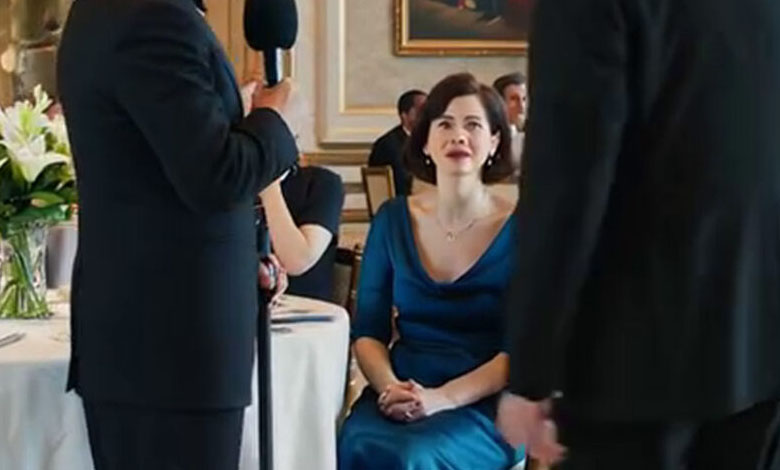
Part One – The Speech
My husband grabbed the microphone at our twenty‑fifth wedding‑anniversary party. The whole family was watching.
“Let’s be honest,” he said, and he actually laughed. “I made the money. She just changed diapers. She is lucky I kept her.”
If anyone had been live‑streaming that moment, they probably would have dropped their jaw, hit replay, and then rushed to the comments. Follow this story to the end, I’d tell them. And if you were watching from anywhere in Chicago, New York, Los Angeles, or any other city in the United States—or halfway across the world—I’d ask you to tell me where you were, just so I could see how far a single moment of truth could travel.
I should have known something was wrong the moment I saw Easton adjusting his tie in that particular way. It was the same precise, sharp tug he used before big investor presentations in downtown Chicago or board meetings out in Silicon Valley.
Twenty‑five years of marriage teaches you to read the signs, even when you wish you couldn’t.
The Grand Meridian ballroom sparkled around us, every surface gleaming under massive crystal chandeliers. We were in the flagship hotel in the chain, the one just off Michigan Avenue, the kind of place where tourists snapped pictures in the lobby because it felt like being inside a movie.
White lilies—my favorite flowers—filled enormous vases throughout the room. Easton hadn’t picked them because they were my favorite, of course. He had chosen them because the event planner said lilies photographed well. The scent was almost overwhelming, sweet and cloying, mixing with the expensive perfume and cologne of our two hundred guests.
I smoothed my hands over the blue silk dress I’d chosen so carefully, a dress I’d paid for with the shared credit card that, in reality, he controlled. Easton had barely glanced at it when I showed it to him earlier that afternoon. He’d been too busy rehearsing his speech, pacing our bedroom in Westfield Manor, our upscale subdivision outside Chicago, going over his notes like he was preparing to ring the opening bell at the New York Stock Exchange.
I had spent three hours at the salon that morning, wanting to look perfect for our anniversary celebration. Twenty‑five years. A quarter of a century. It should have felt like an achievement.
Instead, as I watched Easton glad‑hand his business associates and their wives, I felt invisible. Again.
The children—though at twenty‑three and twenty, I should probably stop calling them that—had flown home for the occasion. Michael stood near the bar with his girlfriend, looking uncomfortable in his rented tux, tugging at the collar like he couldn’t quite breathe. Sarah was at a table near the back with her college friends, chatting animatedly, barely acknowledging my presence when I’d tried to join their conversation earlier.
When had I become a stranger in my own family?
The thought was interrupted by the sharp tapping of metal against crystal. A spoon against a champagne flute. Easton stood at the small stage the hotel had set up, microphone in hand, that familiar, confident smile spreading across his face. The same smile I’d watched charm investors and reporters on CNBC.
The room gradually quieted, conversations fading into an expectant hum.
“Ladies and gentlemen,” his voice boomed through the speakers, and I felt that old flutter of pride I’d always felt when he commanded a room. “Thank you all for joining Antoinette and me tonight as we celebrate twenty‑five wonderful years of marriage.”
Applause filled the ballroom. I managed a smile and clasped my hands together to stop them from trembling. This was supposed to be our moment—our celebration of everything we had built together in America, from a tiny apartment near Northwestern University to this glittering ballroom in a luxury Chicago hotel.
“You know,” Easton continued, his tone shifting to something more casual, more intimate, “I’ve been thinking about what makes a marriage work. What makes it last through all the ups and downs.”
I leaned forward slightly despite myself, curious. We had never really talked about what made our marriage work. We just…existed together. Parallel lives that occasionally intersected.
“And I realized,” Easton said, his smile widening as scattered chuckles rippled through the crowd, “it comes down to knowing your roles. Understanding who brings what to the table.”
Something cold settled in my stomach. The way he said it, the slight emphasis on certain words—it felt wrong. Calculated.
“Let’s be honest here,” Easton said. His voice carried easily through the suddenly quieter room. “I made the money. I built the business. I provided the lifestyle we all enjoy.”
He gestured broadly at the opulent ballroom, at the designer gowns and tailored suits surrounding us.
“Antoinette…well, she changed diapers.”
The words hit me like a physical blow. I felt my breath catch, felt the color drain from my face as the room erupted in uncomfortable laughter. Not real laughter. The kind of forced chuckling people do when they’re witnessing something they know isn’t right but don’t have the courage to stop.
But Easton wasn’t finished.
“She is lucky I kept her,” he said.
This time his smile looked sharp. Calculated. “Really, what else would she do? She has no skills, no education that matters. She’s been living off my success for twenty‑five years.”
The room went completely silent.
Even the waitstaff froze, trays paused mid‑air, like extras in a movie who had forgotten their blocking. I could feel hundreds of eyes on me, feel the weight of their pity and embarrassment pressing down like a physical force.
My hands were shaking now. My vision blurred as tears threatened to spill. Twenty‑five years of my life, reduced to diaper‑changing and luck. Twenty‑five years of supporting his dreams, raising his children, managing his household, playing the perfect wife. All dismissed with casual cruelty in front of everyone we knew.
I started to stand. I needed to escape, to find somewhere to hide and process what had just happened.
Before I could take a single step, another voice cut through the silence.
“Excuse me.”
The voice was calm and controlled, but it carried an authority that made everyone turn, including Easton.
I turned too—and felt my heart stop.
Landon Blackwood stood at the edge of the stage. Tall. Silver‑haired. Completely unchanged in all the ways that mattered.
Twenty‑five years had been kind to him. The angular features I remembered from college had sharpened into something striking. His dark eyes were more commanding than ever. He wore a perfectly tailored black suit that probably cost more than most people’s cars, but he moved with the same quiet confidence he’d had as a struggling design student at Northwestern in Evanston, Illinois.
What was he doing here? How was he here?
Then I remembered: the Grand Meridian was his hotel. He owned the entire chain now. Blackwood Hotels, with properties on four continents and flagship locations in New York, Chicago, Los Angeles, and beyond. I’d read about his success in business magazines over the years, always with a mixture of pride and an ache of regret I’d never examined too closely.
Easton blinked, his confidence faltering for the first time all evening.
“I’m sorry,” he said. “Who are you?”
Landon stepped onto the stage with easy, fluid grace and reached for the microphone.
“I’m Landon Blackwood,” he said. “I own this hotel.”
His voice was pleasant and conversational, but there was steel underneath it.
“And I need to interrupt your speech.”
Easton pulled the microphone back, his jaw tightening. “I’m in the middle of—”
“You’re in the middle of humiliating a remarkable woman,” Landon said. His voice carried clearly even without the mic. “And I won’t allow that to continue in my establishment.”
The ballroom had become a theater. Every guest was riveted, watching the drama on stage. I sat frozen, my heart pounding so hard I was sure everyone could hear it.
Landon gently but firmly took the microphone from Easton’s hand.
When he spoke again, his voice filled the room with quiet authority.
“Ladies and gentlemen, I apologize for interrupting this celebration,” he began, “but I think you should know something about the woman this man just insulted.”
He turned and looked directly at me, and something in his expression made my breath catch. It was the same look he’d given me all those years ago when he’d asked me to marry him in the sculpture garden on Northwestern’s campus. The same look I’d turned away from because Easton had represented safety, security, and everything I thought I needed.
“Antoinette isn’t lucky,” Landon said, his eyes never leaving mine. “She isn’t fortunate to have been ‘kept’ by anyone. She is the one who got away. And I’ve been waiting twenty‑five years for the man who won her to make exactly this kind of mistake.”
The silence that followed was absolute. No one moved. No one seemed capable of processing what they’d just heard.
Easton’s face had gone from confident to confused to something approaching panic.
“What?” he sputtered. “What are you talking about? Who are you to her?”
Landon finally looked away from me and turned to face my husband with an expression I couldn’t quite read.
“I’m the man who loved her first,” he said quietly. “The man who would have spent every day of the last twenty‑five years making sure she knew exactly how extraordinary she is.”
The microphone slipped from Easton’s hand and hit the stage with a sharp screech of feedback that made half the room wince. I barely heard it over the roaring in my ears. My entire world had just shifted on its axis.
Landon loved me first.
Still? Did he still?
“Antoinette,” Landon said, stepping to the front of the stage and extending his hand toward me, “would you like to get some air? I think we have a lot to talk about.”
I looked at his outstretched hand, at Easton’s stricken face, and then at the sea of shocked expressions surrounding us. Two hundred people were watching, waiting to see what I would do—whether I would take the hand being offered to me or stay seated in the chair where I had just been publicly diminished.
For the first time in twenty‑five years, the choice was entirely mine.
I stood. My legs were somehow steady, despite the earthquake happening inside my chest. I walked toward the stage, toward Landon’s waiting hand, toward a future I couldn’t even begin to imagine.
Behind me, Easton’s voice sounded small and panicked.
“Antoinette, don’t you dare. Don’t you dare walk away from me.”
But I was already walking.
And for the first time in decades, I wasn’t looking back.
The cool night air on the private terrace hit my face like a blessing. Landon led me through a discreet side corridor of the Chicago Grand Meridian, away from the stares and whispers that had followed us out of the ballroom. My hand was still in his, and I couldn’t bring myself to let go. It felt like an anchor in a storm I hadn’t even realized was brewing.
We walked in silence through the hotel’s elegant hallways until we reached a set of glass doors that opened onto a private terrace overlooking the city. The lights of downtown Chicago stretched out below us, and for the first time in hours, I could breathe.
“Are you all right?” Landon asked softly as he finally released my hand.
I almost laughed at the absurdity of the question.
Was I all right? My husband had just humiliated me in front of two hundred people, and the man I hadn’t married twenty‑five years ago had just declared his love for me in the same breath. “All right” felt like a foreign concept.
“I don’t know,” I admitted. I wrapped my arms around myself. The evening was warm for Chicago, but I felt cold down to my bones.
Landon shrugged out of his jacket and draped it over my shoulders without asking. It smelled like expensive cologne and something else—something familiar that pulled me straight back to late nights in the studio at Northwestern.
“You were studying industrial design,” he said quietly.
I startled at the unexpected direction of his thoughts.
“At Northwestern,” he continued, his eyes on the city. “You were the most talented student in our program.”
My throat tightened. Nobody had mentioned my design work in years. Not since I’d packed away my portfolio and easel to become Mrs. Easton Crawford, full‑time wife and mother, living the American suburban dream.
“That was a long time ago,” I managed.
“Not so long that I’ve forgotten the lamp you designed for Professor Williams’s class,” Landon said. “The one with the curved glass base that caught light from three different angles. He said it was the most innovative piece he’d seen in fifteen years of teaching.”
I closed my eyes, remembering. I had been so proud of that lamp, so excited about the possibilities it represented. I’d had plans—sketches for an entire line of lighting fixtures that would change the way people thought about illumination in their homes.
Instead, I’d gotten pregnant with Michael, married Easton, and those sketches had ended up in a box in our attic, buried under holiday decorations and old baby clothes.
“Why are you here, Landon?” I asked, needing to redirect the conversation before the memories became too painful. “I mean, I know you own the hotel, but tonight. Why were you in that ballroom?”
He was quiet for a long moment, looking out over the lights of the city.
“I’ve been keeping track of you, Antoinette,” he said at last. “Not in a frightening way,” he added quickly when he saw my expression. “But you were the love of my life. When someone matters that much, you don’t just forget they exist.”
The love of his life.
The words sent a shock through me.
“I knew about the anniversary party,” he continued. “I knew Easton had booked the ballroom. I told myself I wouldn’t interfere, that I wouldn’t disrupt your life. But then I heard him practicing his speech this afternoon.”
My stomach dropped.
“You heard it?” I whispered.
“He was in the presidential suite,” Landon said. “He was going over his remarks with his assistant. The walls aren’t as soundproof as guests think.”
His jaw tightened.
“He was laughing,” Landon said quietly. “Laughing about how he was going to ‘put you in your place’ in front of everyone. How you’d gotten too comfortable lately and needed to be reminded of your ‘position’ in the marriage.”
The words hit me like physical blows.
Easton had planned it. Scripted it. Rehearsed my humiliation like a business presentation.
Twenty‑five years of marriage, reduced to a power play.
“I couldn’t let it happen,” Landon said simply. “I couldn’t stand there and watch him tear you down without doing something.”
When was the last time anyone had stepped in for me like that? When was the last time I had fought for myself?
The answer came with brutal clarity: never.
I had never fought for what I wanted. I had chosen the safe path, the expected path, the path of least resistance.
Like choosing Easton over Landon.
Part Two – The Past and the Offer
The memory hit me with sudden force.
I was twenty‑one again, standing in my tiny off‑campus apartment near Northwestern, staring at two very different proposals—literally.
Landon had gone first. He’d proposed in the campus sculpture garden, down on one knee with a ring he designed himself. A simple band with a small diamond surrounded by tiny pieces of colored glass arranged like a sunburst. He had been broke, living on instant noodles and student loans, but his eyes burned with certainty when he told me he loved me.
“I don’t have much to offer you right now,” he’d said, his voice shaking with emotion. “But I’ll spend every day of my life making sure you never regret saying yes.”
Easton’s proposal came three days later in an expensive restaurant in downtown Chicago. His ring was a traditional solitaire, two carats and flawless. He talked about security, about the life he could provide, about how my future would be safe with him. He had a plan—a five‑year timeline for career advancement, a projected income chart, a list of neighborhoods in Chicago and the Bay Area where he wanted us to look for houses once he made partner.
I had chosen the plan.
I had chosen security over passion, certainty over possibility. At twenty‑one, I convinced myself it was the mature choice, the smart choice.
I had been such a fool.
“Do you remember the project we worked on together?” Landon asked suddenly, pulling me back to the present. “Senior year, the integrated living space design?”
Of course I remembered.
We’d spent three months developing a concept for multifunctional furniture that could transform small spaces—a modular system that reimagined how people lived in city apartments. Professor Chen had said it was graduate‑level work. He’d urged us to consider patenting it.
“It was better than graduate‑level work,” Landon said. “It was market‑ready. We could’ve patented it and started a company. But you dropped out of the program to marry Easton.”
The guilt I’d carried for twenty‑five years pressed down on me.
I’d abandoned our project, left Landon to finish it alone. He’d received full credit, but we both knew it had been a collaboration.
“I’m sorry,” I said. The words felt weak. “I was young, and I was scared.”
“Don’t apologize,” he said firmly. “I’m not telling you this to make you feel guilty. I’m telling you because six months after you left, Easton started a furniture company—Crawford Designs. And his first product line looked awfully familiar.”
The world seemed to tilt.
“What are you saying?” I whispered.
“I’m saying your husband built his fortune on ideas that started with you,” Landon replied. “Ideas you helped create back in Illinois.”
The memory flooded back. Easton asking about my classwork, showing a sudden interest in my projects for the first time since we’d started dating. I’d been so flattered, so eager to share my passion with him that I’d shown him everything—every sketch, every prototype, every innovative concept.
He had listened with apparent fascination, asking detailed questions about materials and manufacturing. I had thought he was trying to understand my world, trying to connect with a part of me he’d never shown much interest in before.
Instead, he’d been taking notes.
“The modular coffee table that launched Crawford Designs,” Landon continued quietly. “The one that could reconfigure into a dining table and storage unit. That was your design, wasn’t it?”
It was.
I had sketched it during a late‑night study session, frustrated by the limitations of my tiny apartment near campus. Easton had found the drawing on my kitchen counter and studied it for nearly an hour, asking me to explain each detail. He’d said he was proud of my creativity.
He’d been proud enough to claim it as his own.
The betrayal washed over me in waves.
It wasn’t just the humiliation in the ballroom. It was twenty‑five years of lies. Twenty‑five years of building a life on stolen dreams. Twenty‑five years of watching my husband take credit for my innovations while dismissing me as “just” a housewife.
“Every major breakthrough Crawford Designs has had,” I said slowly, the pieces clicking into place with horrible clarity—”the expandable shelving system, the convertible workspace furniture, the eco‑friendly materials… I helped develop all of those. I gave him the ideas, helped him talk through the problems, and then…”
“And then he made you feel lucky to be included,” Landon finished. “He made you feel like your contributions were insignificant.”
I thought about all the times I’d tried to talk to Easton about design. About my ideas for improving his products or developing new ones. He’d listen with that patronizing smile, pat my hand, and tell me I didn’t understand “the business side.” He’d made me feel naïve for having opinions about an industry I had once dreamed of transforming.
“Why didn’t you say something?” I asked. “All these years. Why didn’t you tell me?”
“Because you chose him,” Landon said simply. “Because you seemed happy. I didn’t want to be the bitter ex who couldn’t let go. I hoped—” he gave a small, sad smile—”I hoped maybe he truly loved you enough to deserve you.”
He looked back toward the ballroom.
“Now I know better,” he said. “Tonight proved he never really understood what he had. He never saw you the way I saw you. The way I still see you.”