he turned me away like I didn’t matter, but the next morning I used my late husband’s old card I’d found in a drawer, and the bank manager stood up so fast his chair toppled over, whispering, “Ma’am… you need to see this.”
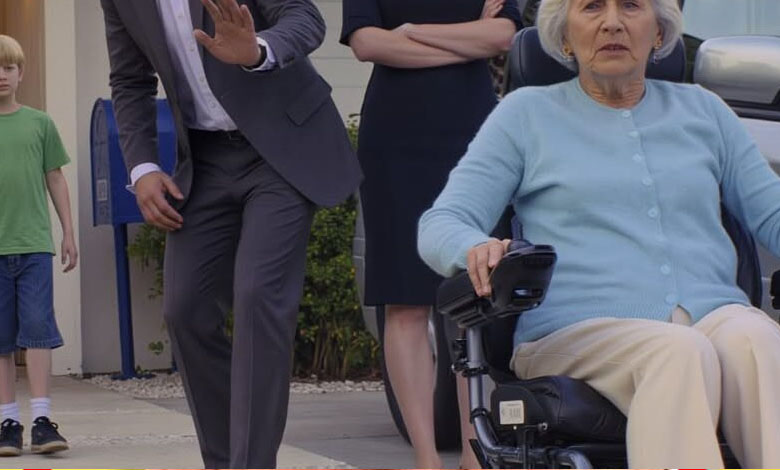
The wheelchair squeaked against the concrete as I rolled up to my son’s front door, my pride crumbling with each desperate push.
Michael took one look at me sitting there with my pathetic suitcase and said the words that shattered what was left of my heart.
“Mom, you can’t stay here.”
But the next morning, I found Robert’s old business card tucked in a drawer.
And suddenly, everything changed when the bank manager nearly knocked over his chair, rushing to help me.
Where are you watching from today?
Drop your location in the comments below and hit that like and subscribe button.
Eight months ago, I thought my biggest problem was learning to live on Social Security after Robert died.
Funny how life has a way of laughing at your assumptions.
The accident happened on a Tuesday.
Isn’t it always a Tuesday when your world falls apart?
I was coming home from the grocery store, arms full of bags because I was too proud to use the cart like other old ladies.
The rain had started, and these Florida sidewalks become slippery as ice when wet.
One moment I was walking, thinking about how I’d stretch the week’s budget to include Robert’s favorite cookies for his memorial dinner.
The next moment I was on the ground, my right hip screaming, and my groceries scattered across the parking lot like confetti at a funeral nobody wanted to attend.
The paramedic, a kid young enough to be my grandson, kept saying, “Ma’am, try to stay calm,” while I lay there calculating how much an ambulance ride was going to cost.
Three surgeries and four months of rehabilitation later, here I am.
Helen Carter, 68 years old, former bookkeeper, current wheelchair enthusiast.
The doctors say I might walk again with enough physical therapy, but physical therapy costs money I don’t have.
Robert’s life insurance barely covered his funeral, and Social Security doesn’t exactly fund miracles.
The house we’d bought 30 years ago when Michael was in high school became my prison.
Everything was upstairs, the bedroom, the bathroom, Robert’s office, where he’d spent countless hours working on projects I never quite understood.
I’d been sleeping on the living room couch for months, using a bedpan like an invalid, showering when my neighbor, Mrs. Patterson, could help me into her accessible bathroom.
My son Michael had visited exactly twice since the accident.
The first time, three days after I got home from the hospital, he spent twenty minutes explaining how busy he was with work and the kids.
The second time last month, he brought Ashley, his wife, who spent the entire visit checking her phone and making comments about how depressing everything looked.
I’d finally swallowed my pride yesterday and called him.
“Michael, I need help,” I’d said, hating how the words sounded.
“I can’t manage here anymore.”
“What kind of help, Mom?”
His voice had that careful tone people use when they’re already planning their escape.
“I need somewhere to stay, just temporarily, until I can figure things out.”
The silence stretched so long, I thought the call had dropped.
Then, “Mom, I’ll talk to Ashley. Let me call you back.”
That was eighteen hours ago.
No return call.
So, I done something I never thought I’d do.
I packed my small suitcase, called a cab, and showed up at their door unannounced.
If my own son wouldn’t help his disabled mother, maybe seeing me face to face would remind him that family meant something.
Or so I’d hoped.
Now, sitting in their driveway, I understood that hope was just another word for delusion.
Their house was a sprawling suburban monument to success.
Three-car garage, manicured lawn, the kind of place that screamed, “We’ve made it.”
An HOA sign sat near the curb like a warning label, and an American flag snapped on a neat porch bracket even in the damp Florida breeze, as if patriotism could polish everything into perfection.
My wheelchair felt like a grocery cart at a Mercedes dealership.
I’d rang the doorbell and waited, listening to the sounds of family life filtering through the walls.
Children’s voices.
Ashley calling out about dinner.
The television playing some cooking show.
Normal life, the kind I used to have.
Michael opened the door in uniform khakis and a polo shirt that probably cost more than my monthly food budget.
His expression when he saw me sitting there was something I’ll never forget.
Not surprise, not concern, but irritation.
Pure, unmistakable irritation, like I was a salesperson who’d interrupted his Sunday afternoon.
“Mom, what are you doing here?”
“I came to see my family,” I’d said, trying to keep my voice steady and to ask for help, but I already knew from his face that I’d made a mistake.
A big one.
“You can’t just show up here like this,” Michael said, glancing nervously over his shoulder.
Behind him, I could see Ashley hovering in the hallway, her arms crossed and her mouth set in a thin line of disapproval.
The grandchildren, my grandchildren, peeked around the corner with curious eyes before being quickly shooed away.
“I called you yesterday,” I said, trying to keep the desperation out of my voice.
“I left a message explaining the situation.”
“Yeah, and I said I’d call you back.”
Michael stepped outside and closed the door behind him as if my presence might contaminate his perfect home.
“This isn’t how we handle family business, Mom.”
Family business.
As if helping your disabled mother was some sort of corporate negotiation that required advanced scheduling and board approval.
“I can’t live in my house anymore, Michael.”
“Everything’s upstairs and I can’t climb stairs.”
“I need help.”
“And you’ll get help,” he said, his voice taking on that patronizing tone he’d perfected in business school.
“But showing up here unannounced isn’t the answer.”
“Ashley has dinner planned.”
“The kids have homework.”
“We have a routine.”
A routine that apparently didn’t include space for his mother.
“I’m not asking to disrupt your routine.”
“Just a place to sleep until I can figure something out.”
“A week, maybe two.”
Michael’s jaw tightened.
“Mom, you know how Ashley feels about unexpected changes to our household dynamic.”
Unexpected changes.
That’s what I’d become.
An unexpected change to their household dynamic.
Not his mother, who’d raised him, worked two jobs to put him through college, and celebrated every one of his achievements like it was a national holiday.
Just an inconvenient disruption to their perfect suburban schedule.
“I helped you buy this house,” I said quietly.
The words slipped out before I could stop them, and I immediately regretted the desperate edge in my voice.
“That was different,” he said quickly.
“That was a loan, and we paid it back.”
Twenty thousand we’d given them for the down payment.
Robert had liquidated his retirement fund early, paying penalties, because Michael needed help getting established.
They’d paid back exactly three thousand before the payment stopped and the subject became too awkward to mention.
“Of course you did,” I said, because what else could I say?
Standing there, or sitting there in my case, arguing about money wasn’t going to change anything.
The front door opened and Ashley appeared.
Her perfectly highlighted hair and Sunday best made me acutely aware of my own appearance.
Sweatpants, an old blouse, and the kind of desperate energy that follows people who’ve run out of options.
“Helen,” she said with a smile so fake it could have been purchased at the dollar store.
“What a surprise.”
“Hello, Ashley.”
Michael tells me you’re having some challenges with your living situation.
Challenges, as if being disabled and broke was just a minor inconvenience, like a leaky faucet or a noisy neighbor.
“I was hoping to stay here for a few days while I sort things out.”
Ashley’s smile never wavered, but something cold flickered in her eyes.
“Oh, honey, I wish we could help, but you know how it is with the children’s schedules.”
“Soccer practice.”
“Piano lessons.”
“Family obligations.”