My name is Olivia Hail, and the last time my father looked me in the eye, he told me I was dead to him.
That was twenty years ago.
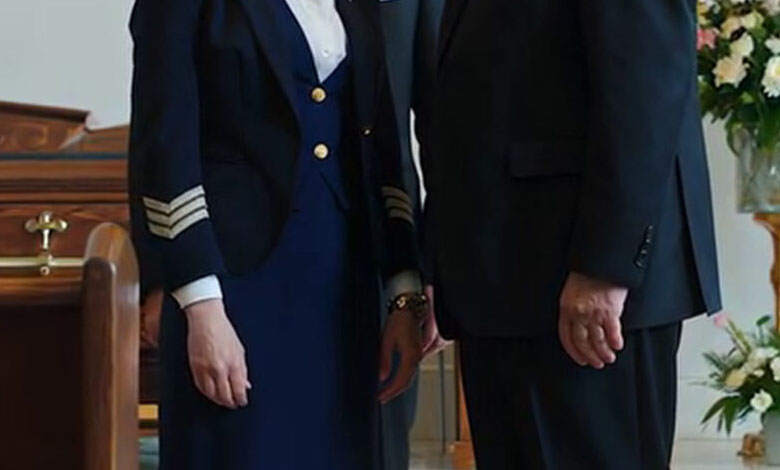
Today, at my mother’s funeral, I stood in full navy dress blues while he walked up to me with that same old smug smile—like I was still sixteen, still scared, still the daughter he thought he could shame into disappearing.
He leaned in and whispered,
“So you finally learned your lesson.”
And in that moment—after two decades of silence, after building a life he never believed I could—I looked him squarely in the face and said,
“Calm as a quiet tide.”
Yeah.
Then meet my husband.
But before I could explain who I became, I need to tell you who I was.
Twenty years earlier, I was a scrawny tenth grader in a small Midwestern town—the kind of place where people still judged you by the church you went to, the shape of your lawn, and whether your family name held up at the Friday football games.
My father cared about all of those things too much. He wasn’t a bad man exactly—just a proud one, a rigid one, a man who thought reputation was something fragile like glass, and it was his job to protect it from scratches.
My mother was softer, quieter, the kind of woman who always kept her hands folded and her sentences short to keep the peace.
I was neither of them.
I was stubborn, curious, and naive enough to believe first love meant forever.
His name was Matthew. He was a year older, worked part-time at the hardware store, and had those soft, scruffy cheeks that made him look older than seventeen. He made me laugh. He made me feel seen. And in all the wrong ways, he made me feel grown up.
I still remember the day the pregnancy test turned positive. I stared at those two pink lines in the cramped stall of the high school bathroom, the sound of girls gossiping and zipping makeup bags echoing off the tiles.
I didn’t cry. Not at first.
I just felt still—like the world had gone quiet around me and only I could hear the ticking of my own heartbeat.
When I told Matthew, he froze. Not the way my father would later, but like a boy suddenly realizing the game he’d been playing had real rules and consequences. He promised he’d figure something out, but by the next week, his mother had transferred him to another school and he stopped answering my calls.
I learned then how fast a future can evaporate.
Telling my parents was harder. I rehearsed it for days, whispering into my pillow at night, imagining my father’s face falling, my mother collapsing into tears.
But reality was worse. Much worse.
It was a Thursday evening. The kitchen smelled like pot roast and onions, and the news hummed low in the background. I waited until dinner was over, until Dad folded his napkin the way he always did—twice, lengthwise, once crosswise—before clearing his throat and asking if I had homework.
“Dad,” I said, my voice cracking. “I need to talk to you and Mom.”
He looked annoyed before he even knew why. That was just how he was.
But when the words came out—
“I’m pregnant,”
the world seemed to split.
My mother gasped and covered her mouth.
My father went still, the redness rising in his neck like a thermometer hitting a boil.
“You what?” he said, voice low, dangerous.
I tried to speak, but he cut me off.
“No daughter of mine is going to bring shame into this house. You want to act like an adult? Fine. Go be one.”
My mother whispered,
“Robert, please. She’s scared.”
But he shoved his chair back so hard it scraped the floor.
“Get out,” he said. “If you walk out that door tonight, you don’t come back.”
I packed my backpack with shaking hands—just clothes, my school books, a framed picture of my mom and me at the county fair. As I walked toward the front door, I felt my mother’s hand brush mine for half a second, soft, trembling.
But she didn’t pull me back. Couldn’t.
She was trapped between the man she married and the daughter she wanted to protect.
Outside, the air was cold enough to sting. I walked to the bus station, sat on a hard plastic bench under buzzing fluorescent lights, pulled my jacket around me, and pressed my palm against the small swell of my stomach.
It wasn’t really showing yet, but I needed the contact—something to tether me, something to remind me I wasn’t truly alone.
That night, I learned what loneliness tasted like. And fear. And anger.
And something else, something small but powerful: resolve.
Because while my father believed kicking me out would break me, something inside me whispered that I had to survive. Not just for me—for the little heartbeat growing inside me.
I spent the next few days bouncing between couches and spare rooms, trying not to outstay my welcome. A high school counselor slipped me a list of shelters and support centers. A kind woman at church gave me two bags of groceries.
And yet shame clung to me everywhere I went. I heard whispers. I saw judgment in eyes that used to greet me with warmth.
But I also learned something my father never understood.
Kindness can grow in the cracks where pride collapses.
And strangers can sometimes give more love than blood.
The first weeks of pregnancy were a blur of nausea, exhaustion, and fear of what came next. But somewhere in the middle of all that, a seed of strength began to grow—slow, stubborn, and steady.
A strength I didn’t know I would need for the next twenty years.
And a strength my father would come face to face with at my mother’s funeral.
The weeks after I left home felt like moving through thick, freezing fog—every step heavy, every breath uncertain. I had no plan, no money beyond what I’d saved from babysitting, and no one I felt I could burden for too long.
People were kind in small, fleeting ways: a pastor who offered a warm meal, a classmate’s mother who let me stay on their couch for two nights, a grocery store clerk who quietly slipped an extra box of crackers into my bag.
But nothing was stable, and nothing was mine.
By the end of the second week, exhaustion hit me like a freight train. I was nauseous most mornings and terrified every night. Walking through town, I kept imagining my father’s truck slowing beside me, his voice ordering me back home with that mixture of anger and authority I had grown up under.
But he never came. Not once.
He had meant every word when he said I was dead to him.
The turning point came one cold Saturday morning. I was sitting on the curb outside the library, hugging my backpack—my makeshift suitcase—while my breath curled like smoke in the air. I hadn’t eaten since the day before, too embarrassed to ask the church pantry for more food.
That’s when a small older woman stepped out of the library door. She wore a powder-blue cardigan and held a stack of returned books against her chest. She looked at me for a long second—not with judgment, but with recognition.
“Honey,” she said softly. “You look like you need a warm place to sit.”
Her name was Mrs. Callahan, though she asked me to call her Irene. She’d been a widow for years, lived alone in a little house with mint green shutters, and volunteered at the library to have a reason to get out of the house, as she put it.
She didn’t know my story when she first invited me in for tea. She just knew what loneliness looked like.
Inside her home, everything smelled faintly of cinnamon and lemon cleaner. She poured tea, cut a slice of banana bread, and waited—not prying, not guessing—until I spoke.
And when I finally did, explaining the pregnancy, my father’s reaction, and the nights I’d spent bouncing from place to place, she didn’t gasp or scold or look disappointed.
She simply reached out, patted my hand, and said,
“No child should go through that alone.”
That afternoon, she offered me her basement room. It wasn’t much—a small space with a twin bed and a narrow window—but it was warm, safe, and mine.
I cried that night silently, partly from relief and partly from the sting of realizing how quickly my own family had thrown me aside compared to how gently a stranger held space for me.
Living with Irene didn’t solve everything, but it gave me stability. She taught me how to budget the little money I earned at a diner job she helped me find. She drove me to prenatal appointments when the nausea became overwhelming. She taught me how to make a grocery list, how to stretch a dollar, and how to stand tall when people whispered behind my back at the store.
“You don’t owe them a single explanation,” she’d say. “Shame only grows when you feed it.”
Slowly, I finished my GED coursework at night. The adult education center was in a converted office building beside the highway, smelling of old carpet and dry erase markers. Most students were older—laid-off workers, single parents, folks trying to start over.
I fit right in.
In their eyes, I wasn’t the pregnant teenager who had embarrassed her family. I was just another person trying to build a future.
One evening after class, a man in uniform stood near the front desk, chatting with a few students. He wore navy blues, his posture crisp, his smile easy. The patch on his arm caught my eye before anything else—an anchor.
Something about that symbol—steady, grounded—pulled me closer.
He was a Navy recruiter doing an outreach visit. When I passed nearby, he nodded politely.
“Evening. You thinking about next steps after your GED?”
I hesitated.
“Not really. Just trying to get through this week.”
He smiled gently, as if he heard the truth in my voice.
“If you ever want to talk options, the Navy has programs for young parents. It’s not easy, but it’s steady work. Structure. Healthcare. Housing.”
The words settled in me like stones sinking into still water.
Structure. Healthcare. Housing.
All the things I desperately needed.
I brushed it off at first. I couldn’t imagine myself in uniform. I barely believed I could make it through the month.
Then came the night when worry nearly swallowed me whole. I woke up with sharp cramps. Nothing dangerous, the doctor said the next day—just stress.
But in those dark hours, I realized just how fragile my situation was. I needed more than kindness and temporary solutions.
I needed a future.
I started researching quietly. Reading pamphlets. Watching videos. Talking to the recruiter again, this time with real questions. He didn’t sugarcoat anything. Boot camp would be brutal. I’d have to leave my baby for the duration—eight weeks. That would feel like a lifetime. My child would need a guardian during that time.
When I told Irene, she didn’t hesitate.
“If this is what you want, I’ll take care of the baby. I raised three boys. One more won’t scare me.”
I cried then, not out of fear, but out of love so unexpected it broke me open.
The day my baby was born, I held that tiny warm bundle against my chest and whispered a promise.
“You will never know the kind of abandonment I did. I will build us a life no one can take away.”
Motherhood at sixteen was overwhelming. Nights blurred together—diapers, bottles, exhaustion so deep I felt hollow. But every time I looked at my child, those soft eyes, those tiny fingers curling around mine, I felt a fire inside me growing stronger.
Three months later, I shipped out for basic training.
Standing at the airport, watching Irene hold my baby close while I stepped toward the gate nearly shattered me.
But I kept walking, because sometimes walking away from your past is the only way to walk toward your future.
I didn’t know it then, but that decision would shape the next twenty years of my life and lead me right back to the church steps where my father would freeze at the sight of the woman he never imagined I could become.
Boot camp stripped me down to nothing and rebuilt me from the bones outward. The first morning, before the sun even thought about rising, a whistle shrieked through the barracks and boots thundered across the floor.
I shot upright, heart pounding, thinking for a split second that I was back in my father’s house and he was yelling again.
But this time it wasn’t anger.
It was command. Structure. Purpose.
“On your feet! Move, move, move!”
Those first weeks were a blur of sweat, aching muscles, and swallowing fear just to make room for determination. I was younger than most recruits, but carried more weight inside than any of them could see.
When we were ordered to run miles in the cold dawn, I thought of my child sleeping safe in Irene’s arms. When we crawled under barbed wire on our bellies, I thought of the night I’d been thrown out of my home. When a petty officer told me I didn’t have what it took, I heard my father’s words echo—dead to me—and I shoved myself farther, faster.
I wasn’t the strongest. I wasn’t the fastest.
But I was the one who refused to quit.
I found my footing slowly, made a few friends, learned how to take orders and how to breathe through the moments when my chest tightened with missing my baby. Letters from Irene were my lifeline. She wrote about the baby’s first giggle, the first time tiny fingers wrapped around hers, the way my child looked toward the door as if expecting me to walk in.
I cried quietly into my pillow after lights out, muffling the sounds so no one would hear.
But every tear sharpened my resolve.
By the time I graduated basic, I stood straighter. My uniform fit not just my body, but some part of my spirit I hadn’t known was waiting for it. When they pinned my insignia on, I imagined my mother clapping softly and my father standing in the back pretending not to be proud.
But reality was different.
The only person waiting at home was Irene, rocking my baby on her porch swing.
And somehow, that was enough.
The Navy sent me to specialized training next—logistics. It wasn’t glamorous, but it was the backbone of operations. What goes where, who gets what, how supplies move to keep everything functioning. It appealed to the part of me that craved order after a childhood of emotional chaos.
Schedules. Checklists. Procedures.
Training was demanding, but I discovered something surprising.
I was good at it.
Good at problem solving. Good at staying calm when others panicked. Good at seeing connection points others missed.
My instructors noticed. For the first time in my life, authority figures didn’t look at me with disappointment. They looked at me with belief.
Every time I earned a certificate or passed an evaluation, I tucked the paperwork into a folder I kept in my wall locker. On the front, I taped the Christmas card my mother had secretly sent me months earlier—a quiet reminder that somewhere beneath all the silence and shame, she still cared.
When I finished my schooling, I received orders for my first duty station. Stepping off the transport plane, seeing rows of sailors moving with practiced efficiency, hearing the hum of engines and cranes, smelling the mix of salt, diesel, and hot pavement, I felt for the first time that I belonged somewhere.
I sent money home as soon as I could, insisting Irene spend some on herself even though she protested. She was the only family I had left, and she was raising my child with more love than I’d ever known in my own home.
Life settled into a rhythm—work, sleep, calls home when time zones lined up. I missed birthdays, first steps, first words, each absence carving a quiet ache into my heart.
But every reunion filled that ache with something stronger: gratitude.
My child ran to me with open arms every time I came home on leave, babbling stories and clinging to my uniform with sticky little hands. Their laugh became my favorite sound.
Years passed. I learned to lead small teams, then larger ones. I gained the trust of officers who’d once doubted a young mother could handle the stress. I got promoted, then promoted again.
The girl who’d slept on buses and couches now managed operations worth millions of dollars.
My father’s prediction that I’d ruined my life faded like fog, burned off by morning sun.
Still, there were nights I lay awake staring at the barracks ceiling or the small apartment I later rented, wondering about my parents, wondering if my mother thought of me, wondering if my father ever softened.
But the past was a room I kept shut—too dusty and painful to revisit.
One memory lingered above the rest.
The day I returned home on leave when my child was four, I wore my uniform—crisp, pressed, ribbons neatly aligned. Irene had dressed my child in a little outfit and brushed their hair with such care. We decided to walk into town for ice cream.